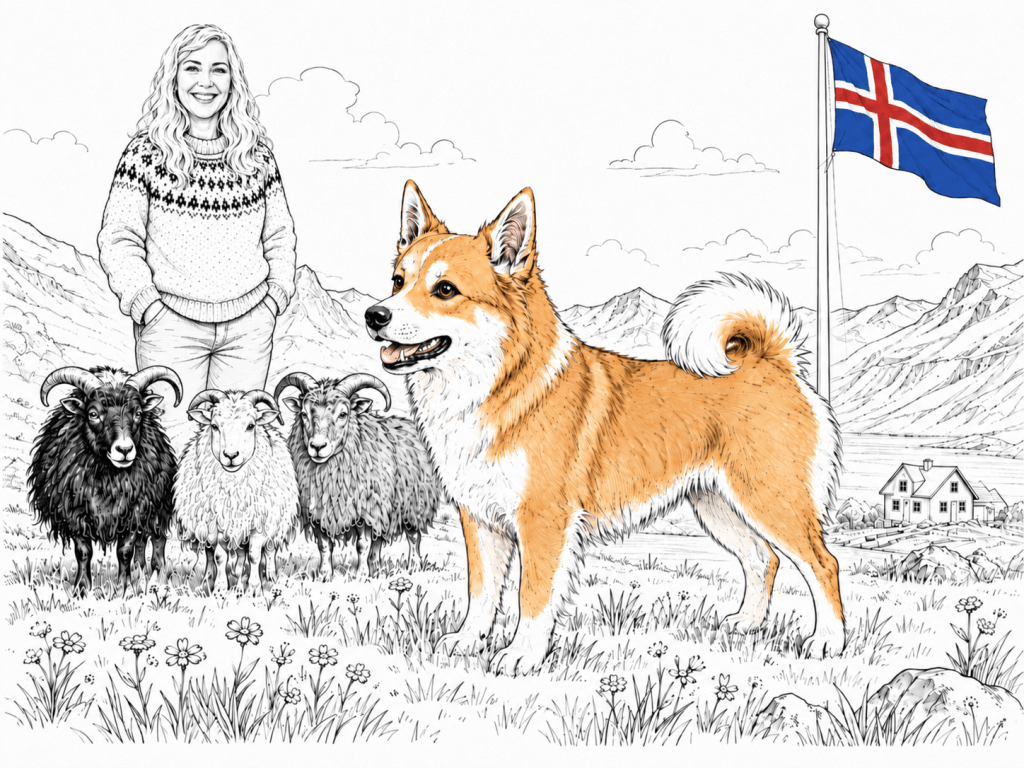
On 18 July, Iceland celebrates its only native breed — and the date is no accident. It is the birthday of Mark Watson, the Englishman who realised in the middle of the last century that the Icelandic Sheepdog was quietly dying out, and set about saving it. The breed’s day is, quite literally, named for one of its guardians.
The dog itself came with the settlement ships more than eleven hundred years ago and has been doing the same work ever since — moving sheep across country that breaks lesser dogs, and announcing every visitor with total conviction.
I feel a deep pride in our national dog. Not only in the breed itself, but in the people who came before me and worked, often against the current, to make sure it still exists. That is what this day was made for. And this year the pride carries grief with it, because in May we lost one of the breed’s great guardians.
Everything has a purpose
When I was researching the breed for the first time years ago what took me aback was the gentleness. And the slow realisation that nothing on this dog is decorative.
The ears are erect, triangular and constantly in motion — the standard calls them “very mobile, reacting sensitively to sounds.”
The bark is written into the standard as a working tool — the breed herds and drives by voice. A judge who resents the voice has misunderstood the dog.
The double coat, short or long, is thick and extremely weather-resistant — built not for the ring but for horizontal rain in June.
Even the dewclaws tell the story. Well-developed double dewclaws on the hind legs are desirable under the standard but they are there for grip on scree and frozen slopes.
And the movement. I remember standing at the ringside watching them run, and the word that kept coming was effortless. You could believe, watching them, that these were working dogs — the standard asks for exactly that: agility and endurance, covering the ground effortlessly. A dog that tires at hour two is no use at hour ten.
For the Icelandic farmer there was never an off day. The dog worked in every weather, or sheep died. That is what the standard protects.
Variety of colours
The standard puts it simply: fawn and red from cream to reddish brown, grey shaded, chocolate brown, and black — and white always accompanies the main colour.
Almost lost
The breed nearly disappeared. By 1950 the Icelandic Sheepdog was at real risk of extinction, diluted by imported dogs and reduced by disease. Mark Watson sounded the alarm: travelling Iceland, he found pure-type dogs only on isolated farms in the remotest valleys and fjords, took ten of them to his kennel in California to secure the gene pool, and in 1956 published the first comprehensive research on the breed. Organised breeding resumed in Iceland in 1967, HRFÍ was founded in 1969 with the breed’s preservation as a core purpose, and in 1972 the FCI recognised the breed definitively. That is the rescue people have heard of — the one the calendar remembers every 18 July.
Another fact that not everyone knows about. From 1924, keeping dogs was banned in Reykjavík, and bans held in most Icelandic towns for six decades. Iceland’s national dog was, in effect, outlawed in its own capital.
Guðrún Guðjohnsen, the legend
Guðrún Guðjohnsen was born 31 January 1934 and died this May, aged 92. Chairwoman of HRFÍ, breeder, judge, long-serving board member of the Icelandic Sheepdog division, honorary member — and the person who led the long battle with the City of Reykjavík that ended the sixty-year ban, holding course even when a 1988 referendum went against dog owners. In 1996 she initiated ISIC, the international cooperation that made the breed’s survival the shared responsibility of clubs far beyond Iceland’s shores.
I was fortunate to hear from Guðrún directly while I was learning about the breed, ten years ago — what she valued in the Icelandic Sheepdog, and what she believed judges must remember when they take this breed into their rings. That is something that I will cherish forever.
Eleven hundred years, and counting
The breed survived extinction and being outlawed because individual people decided it mattered. On 18 July I will be thinking about how thankful I am for the people who worked so hard for that being a reality.
Sources
- FCI Standard No. 289 — Íslenskur Fjárhundur (03.07.2018)
- Þórhildur Bjartmarz, “Memorial words for Guðrún Ragnars Guðjohnsen,” fjarhundur.is, May 2026
- “Mark Watson — the savior of the Icelandic Sheepdog,” fjarhundur.is
- The Icelandic Sheepdog — history and heritage, fjarhundur.is
- Mark Watson, The Iceland Dog 874–1956 (Nicasio, California, 1956)
- Deild íslenska fjárhundsins (DÍF)
- “Icelandic Sheepdog Celebrated Today,” Iceland Review
 Viktoría Jens
Leave a comment