Article based on Petra Junehall’s article about the breed in Domarebladet 2016 & valuable insights from Judge Dagmar Klein.
The land beyond the forest
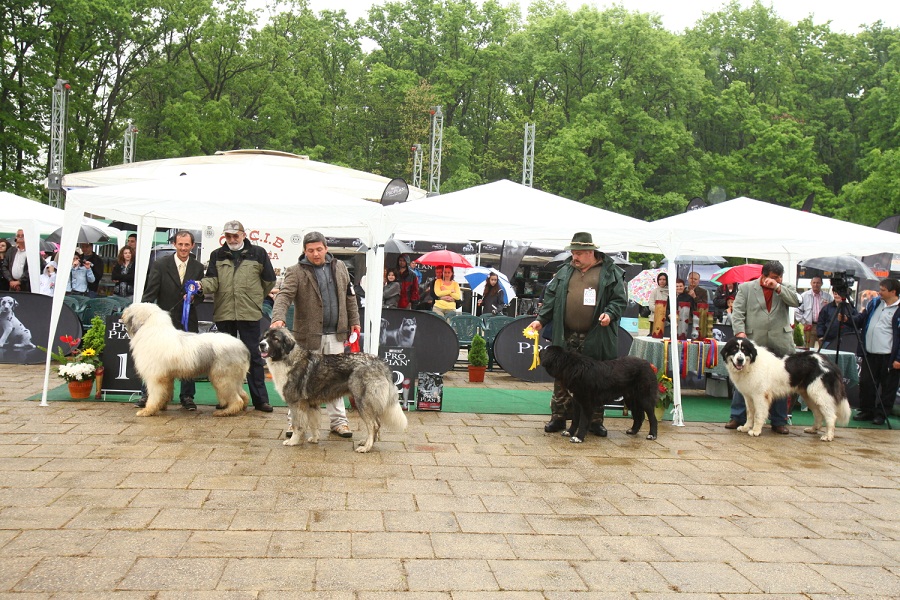
Transylvania. The name comes from Latin — trans silvam, “beyond the forest.” For most of the world it arrives wrapped in Dracula’s cape. For a working shepherd in the Carpathian mountains, the name means something simpler and older: the land where the sheep go up in summer and come down in autumn, and the dogs go with them.
Romania’s shepherd tradition is not a memory. Transhumanța — the seasonal movement of flocks between lowland pasture and mountain meadow — is still practised. Wolves are still real. Brown bears are still real. And four breeds of dog, shaped by those same mountains, still work.
Four breeds. Not one type with regional variations. Four breeds, each with its own FCI standard, its own silhouette in the ring, its own judging priorities. If you have been in the sport long enough to remember when they all got lumped together as “Romanian sheepdog,” it is time to unlearn that.
The four breeds
The Fédération Cynologique Internationale recognises them as follows:
- Carpathian Shepherd — FCI 350, Group 1. Wolf-sable coat, lupoid head, the athletic herder.
- Mioritic Shepherd — FCI 349, Group 1. White or grey, 10-centimetre wavy coat, the large guardian whose structure is concealed under extraordinary hair.
- Bucovina Shepherd — FCI 357, Group 2. White with bold patches of black, fawn, or brindle. The heaviest of the four. The molossoid guardian.
- Raven Shepherd (Corb) — FCI 373, provisional since September 2024. Entirely black, every surface, every coat. Not yet CACIB eligible. The newest recognised dog in the Romanian lineage and the one most judges will have never seen in person.
The first three share a history of being used interchangeably in the ring by judges who did not yet have the standards in their hand. That phase is over. The fourth — the Corb — is currently where the first three were twenty years ago: a breed whose advocates are working hard to establish it, and whose standard judges will need to learn from scratch.
Carpathian Shepherd — the herder
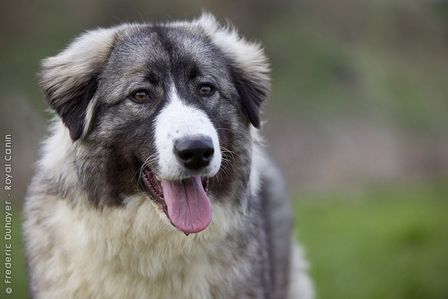
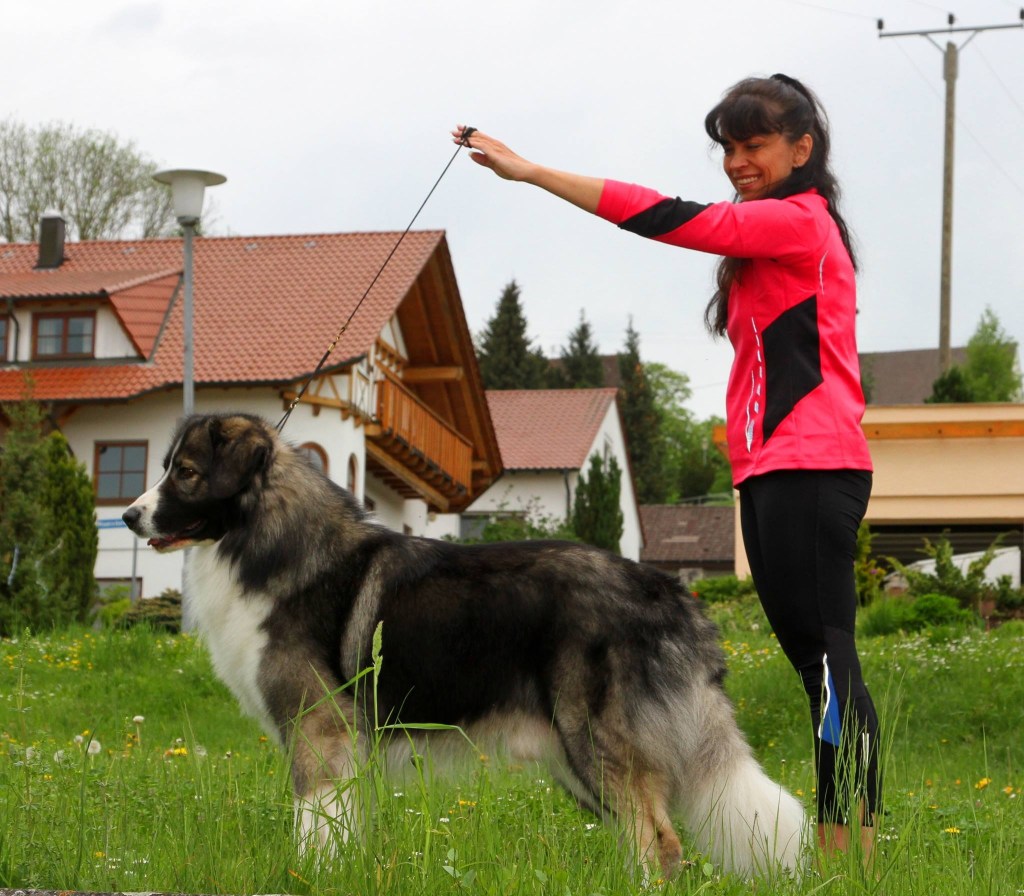
The Carpathian (FCI 350) is the athlete of the four. A lupoid head. A balanced, almost wolflike silhouette. Wolf-sable coat — fawn base with black tips, and the black pattern is the breed’s signature. A harsh double coat of 6–9 centimetres, built for weather rather than for glamour.
Size: 65–73 centimetres at the withers for males. Weight: 32–45 kilograms. This is not a giant dog. This is a mobile, cover-ground, stay-with-the-flock dog.
In the ring, the judging priority is structure that can still work. Lupoid type — never molossoid. The wolf-sable colour must be present and correct; solid colours are faults. The head carries the breed: almond-shaped eyes, medium-length muzzle, clean lines. A Carpathian that looks like a shepherd dog from any other mountain range is wrong for the breed.
Mioritic Shepherd — the poem made flesh
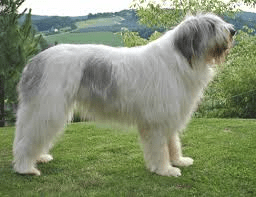
The Mioritic (FCI 349) is named for the Miorița, the Romanian pastoral ballad that every Romanian schoolchild learns. In the ballad, a young shepherd is warned by his favourite ewe that the other two shepherds plan to kill him. It is a poem about fate, about the land, about the companionship between a shepherd and his flock. That the country’s largest shepherd breed carries that name is not an accident.
This is the breed most people mean when they picture a Romanian livestock guardian: very large, heavily coated, white or cream or grey — all equally correct. Males reach 70 centimetres and above. Weight 50 to 70 kilograms. The coat is a minimum of 10 centimetres, wavy, never corded.
Here is the judge’s trap: the coat conceals the structure. A show Mioritic, presented well, can be read as “correct outline” when the dog underneath is overweight, under-muscled, or weak in topline. Feel under the coat. Always feel under the coat. Judges who do not put their hands on a Mioritic are judging hair.
Colour fault note: all three base colours — white, cream, grey — are equal. There is no “preferred” colour. Rewarding a white dog over a grey dog on aesthetics is a judging error, not a breed preference.
Bucovina Shepherd — the mountain
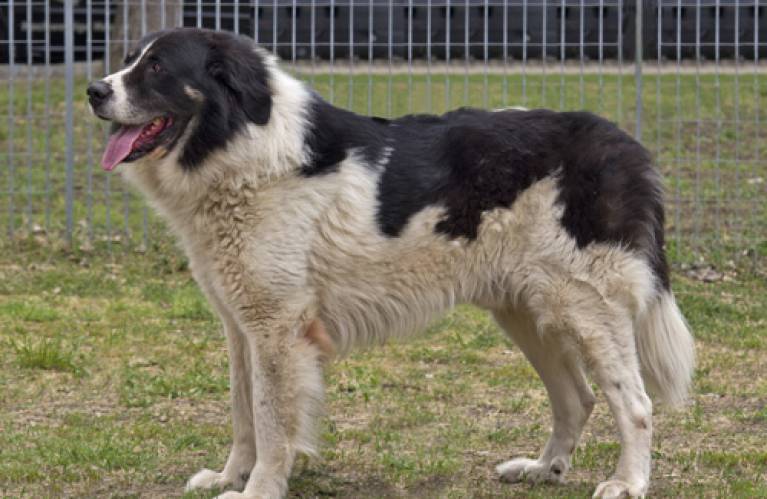
The Bucovina (FCI 357) is the heaviest of the four. Bucovina the region sits at the northern edge of Romania, bordering Ukraine — colder, more forested, with a different livestock-guardian need than the southern Carpathian ridge. The dogs reflect that. Males 68–78 centimetres, 50–90 kilograms. Massive, molossoid, slower-moving than a Carpathian, built for confrontation rather than flanking.
Colour is distinctive: white with bold patches of black, fawn, or brindle. A predominantly white dog with well-placed patches is correct. A dog that is mostly coloured with white trim is wrong. Coat is 6–9 centimetres, harsh, dense.
Judging priority: the Bucovina’s size is a feature, not a fault. Some judges coming from working-breed backgrounds instinctively reward a more athletic silhouette in the Bucovina ring. That instinct is wrong for the breed. A correctly massive Bucovina that moves soundly is a better example than a smaller, faster one. The breed was built to stand between a flock and a bear, and it is judged accordingly.
Corb — the raven
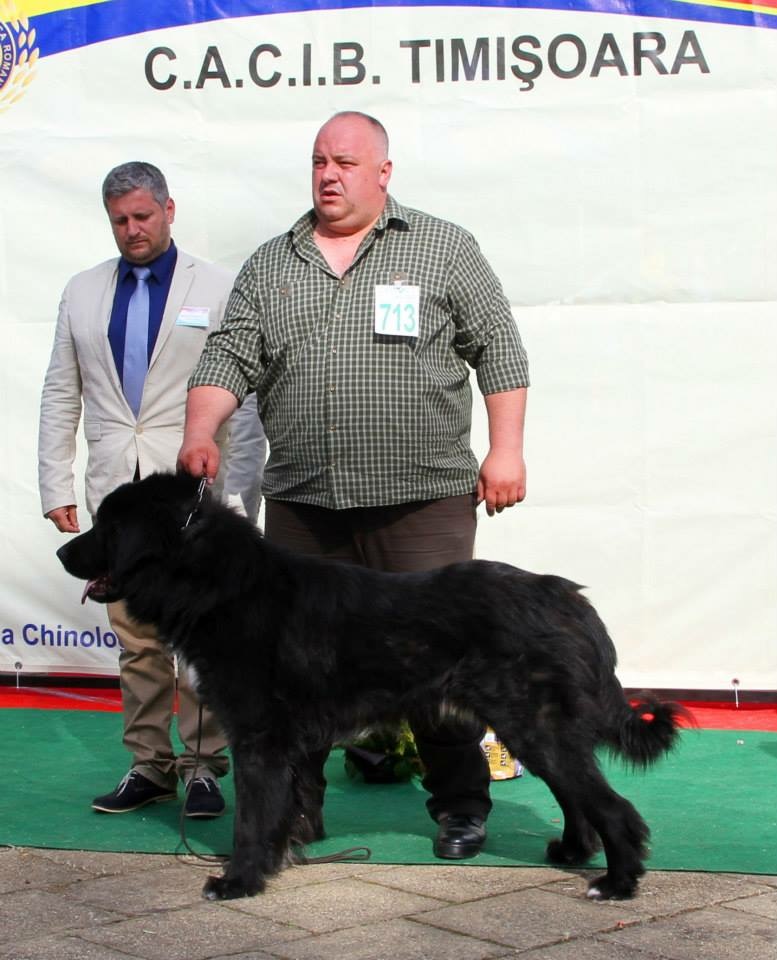
The Raven Shepherd, or Corb in Romanian, is FCI 373 — provisional since September 2024. The breed’s signature is singular: entirely and uniformly black. Every surface. Every undercoat. Every hair.
Size: 70–80 centimetres at the withers for males, 45–60 kilograms. Tall, agile, more mobile than the Bucovina and heavier than the Carpathian. The coat is 7 to 10 centimetres, dense, and the pigment rule is absolute — any white, fawn, or brindle disqualifies the dog from the breed. The same pigment rule extends to eye rims, nose, pads, and mouth.
Because the Corb is provisional, it is not yet CACIB eligible. A judge encountering one in the ring in 2026 is almost certainly working at a specialty or national show. Judges should approach the breed with the standard in hand and without assumptions drawn from the other three — the Corb is not “a black Mioritic” or “a black Bucovina.” It is its own thing, historically bred in the Apuseni mountains for a specific role, and its standard deserves to be read rather than inferred.
Why these breeds look the way they do
Wolves. Bears. Cold weather. Nights that last longer than the day in winter. Flocks of hundreds of sheep moving across terrain that a car cannot reach. The four breeds look the way they do because the work is still real.
Most of Europe’s livestock-guardian breeds exist now as a memory of their function. The Romanian breeds still perform it. That is the central fact a judge must hold when reading these dogs. You are not judging a historical curiosity. You are judging the living end of an unbroken line of work.
What a judge is actually looking for
Across all four breeds, four questions carry most of the weight.
- Is the colour correct? Wolf-sable on the Carpathian. White / cream / grey on the Mioritic. White plus patches on the Bucovina. Entirely black on the Corb. No compromise on colour — it is the first readable breed marker.
- Can this dog still do the work? Sound movement, working-level stamina, balanced angulation, good feet. A dog that cannot walk a day across a mountain is not correct for any of the four breeds regardless of ring beauty.
- Is the temperament right? Confident, self-possessed, appropriately reserved with strangers, never aggressive on the table and never soft and anxious. These are guardian dogs. They should carry themselves like dogs with a job to do.
- Does the structure match the breed, not a neighbouring breed? Lupoid on the Carpathian. Large-and-coated on the Mioritic. Massive-and-patched on the Bucovina. Tall-and-uniformly-black on the Corb. A dog that reads as a generic “mountain dog” is judged generically — which is to say, judged wrong.
Why this matters
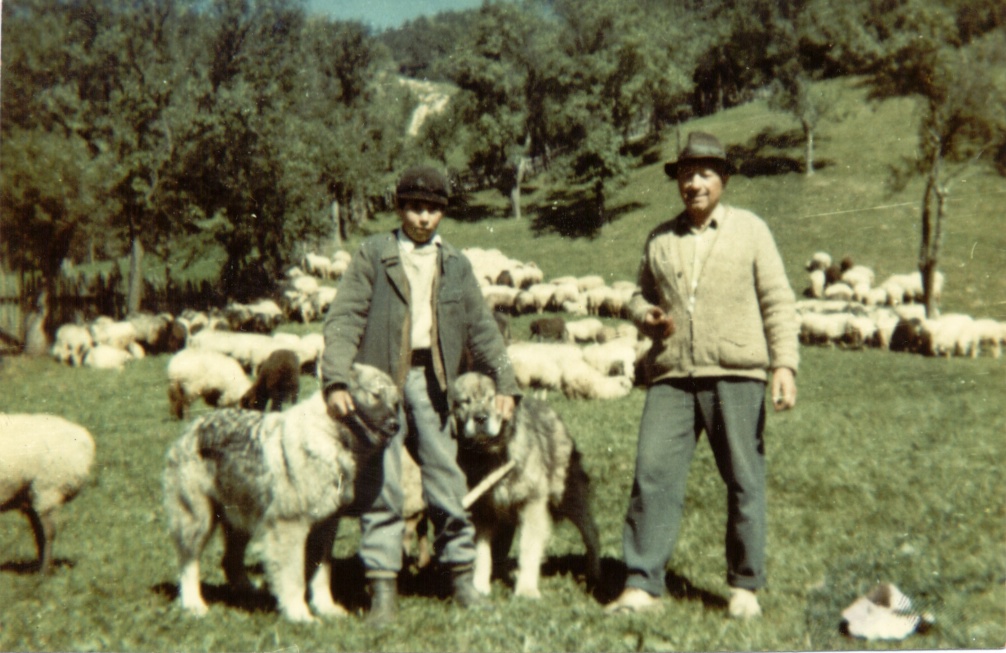
Romania’s four shepherd breeds are one of the last intact living working traditions in European dog breeding. The dogs are still being used, the mountains are still there, and the wolves have not read any breed standard. Judges who reward dogs that could still do the job are holding the door open for these breeds to remain what they have always been. Judges who reward cosmetic correctness only are quietly closing that door.
Pick up the standards. Feel under the coat. Reward the dog that still has the work in it.
The views expressed here are my own. Judges and breeders should always refer to the FCI breed standard as the authoritative reference.
Sources
Junehall, Petra. “Romanian Shepherd Breeds.” Domarbladet No. 1, 2016. Svenska Kennelklubben.
Current FCI Breed Standards: No. 349 (Mioritic Shepherd, Group 1), No. 350 (Carpathian Shepherd, Group 1), No. 357 (Bucovina Shepherd, Group 2), No. 373 (Raven Shepherd / Corb, Group 2) — provisional, September 2024.
Photographs reproduced with permission of Petra Junehall and Dagmar Klein.
Viktoría Jensdóttir is an FCI licensed international dog judge based in Iceland. She writes about breed judging, Lean thinking, and the cross-domain connections between them at viktoriajens.is.
 Viktoría Jens
Leave a comment