This is the article which I think many people think about when they have decided that Schnauzer is the dog for them: which Schnauzer is the right one for me? The polite answer is “it depends.” The useful answer is more honest than that, and the honest version is what follows. I think all breeders would rather lose a sale for someone else’s puppy than help someone bring home a dog they cannot meet on the dog’s own terms.
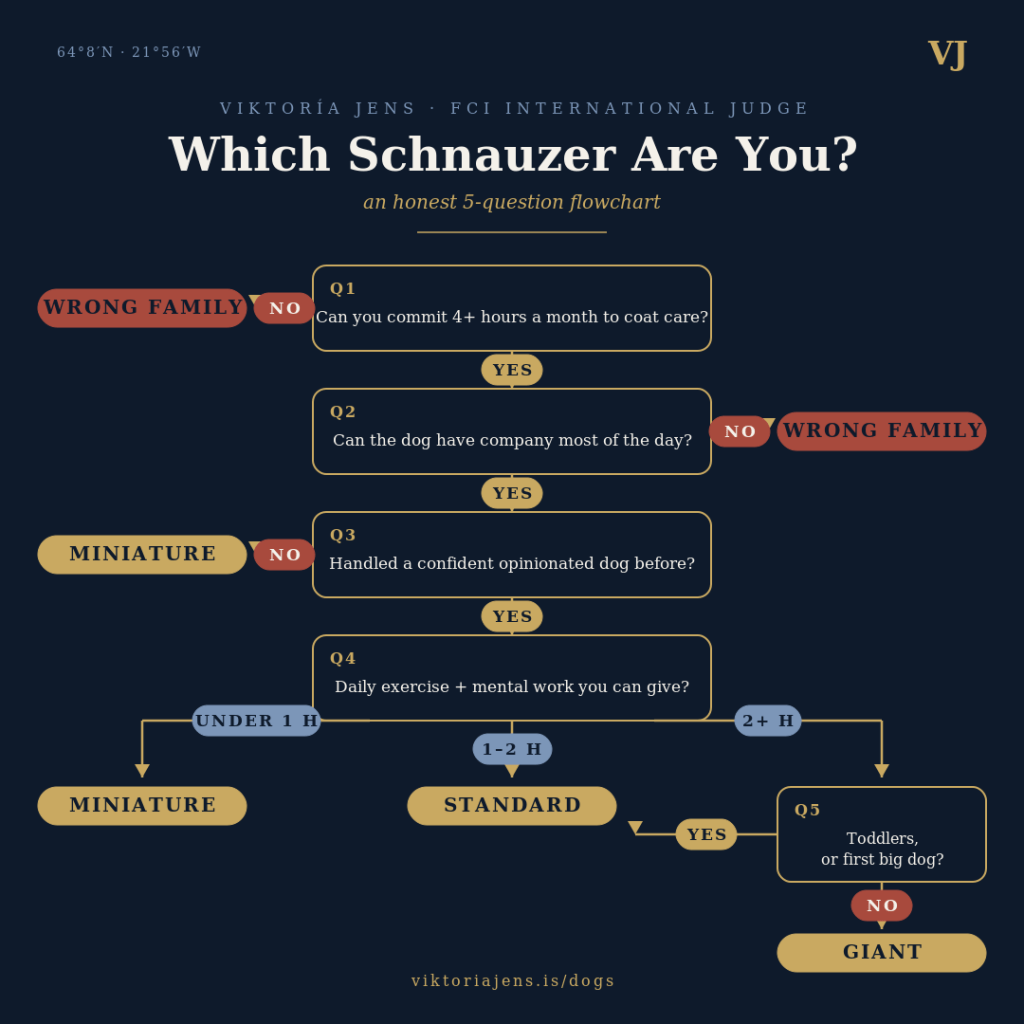
If you would prefer the five-minute version, the Which Schnauzer Are You? quiz at the end of this article gives you a starting answer. This article gives you the reasoning behind the answer.
First, the rule that applies to every size
The Schnauzer family is clever, opinionated, watchful and made for work. The Danish Kennel Club’s breed page captures it well: lively and energetic, paired with measured calm and unconditional loyalty, watchful without being sharp or excessively barking. You could also add that they are alert, lively and highly aware of its surroundings, with enough self-confidence to think for itself.
That last part is not flattery. It is a warning. A Schnauzer who has not been given a job will invent one. The job they invent is rarely the one you would have chosen.
Across all three sizes, two things are non-negotiable for any responsible owner:
- The dog needs mental work every day, not only physical exercise.
- The dog needs company, not eight to ten hours alone in a kitchen.
If either of those is a no, the responsible answer is a different breed family — and that is not a failure, it is a good decision.
A note on popularity, because it shapes everything
The Miniature Schnauzer is consistently one of the more popular breeds across Europe and North America, often sitting comfortably in the top twenty of national registration tables. The Standard Schnauzer — the prototype — is much rarer in most countries, sometimes producing only a few hundred puppies a year nationally. The Giant Schnauzer sits in between in popularity, more common in working-dog circles than as a household pet.
This matters when you choose a breeder. With a popular breed like the Miniature, a careful buyer can be picky and still find good options. With a Standard, you may need to wait for the right litter or import from a breed-club breeder in another country. With a Giant, you should be talking to working-line breeders specifically, because show-only Giant lines have drifted in some countries toward heavier or more elegant types that are no longer the working dog the standard describes.
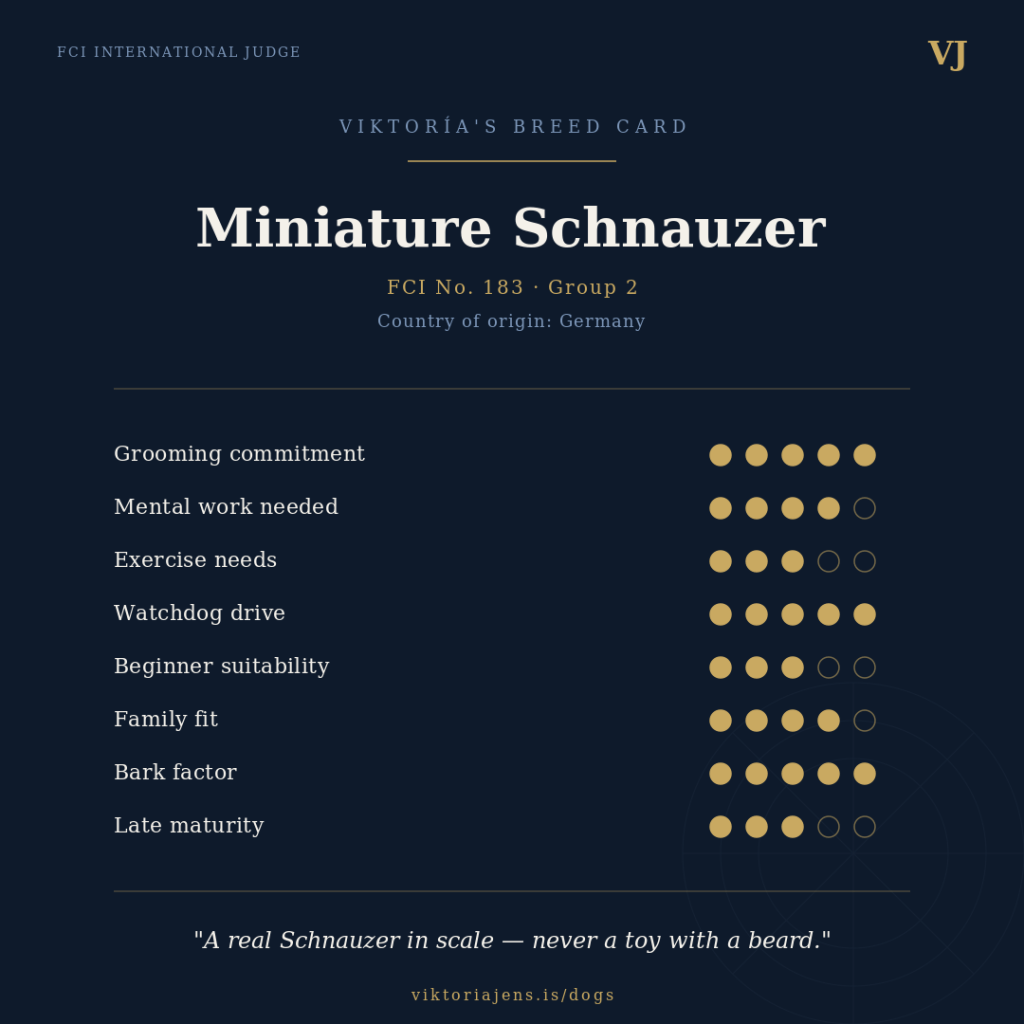
Miniature Schnauzer (FCI 183)
Best for: active families and individuals in apartments or smaller homes who want a clever small dog with real character. People who like training and small-dog sports. Households who genuinely enjoy a watchdog who will tell them when the postman is on the path.
Tough for: anyone hoping for a quiet small dog. Households with small caged pets the dog will see as legitimate prey. People who want low grooming. Households where everyone is gone all day with no enrichment.
The honest part: the Mini’s biggest risk is not the breed; it is the owner who treats it like a toy dog. A Mini is the same Schnauzer in a smaller body. It is bold, vocal, opinionated and very smart. It will outwit a casual owner inside three months. Train it like a real dog from week one and you will have a brilliant family companion. Carry it everywhere and feed it from the table and you will have a small, sharp-toothed dictator. Both outcomes are within the breed’s range.
The grooming reality: every six to eight weeks at minimum if hand-stripped, or a clip and tidy if you choose pet trim. The cost over a Mini’s lifetime is significant; budget for it before the puppy comes home.
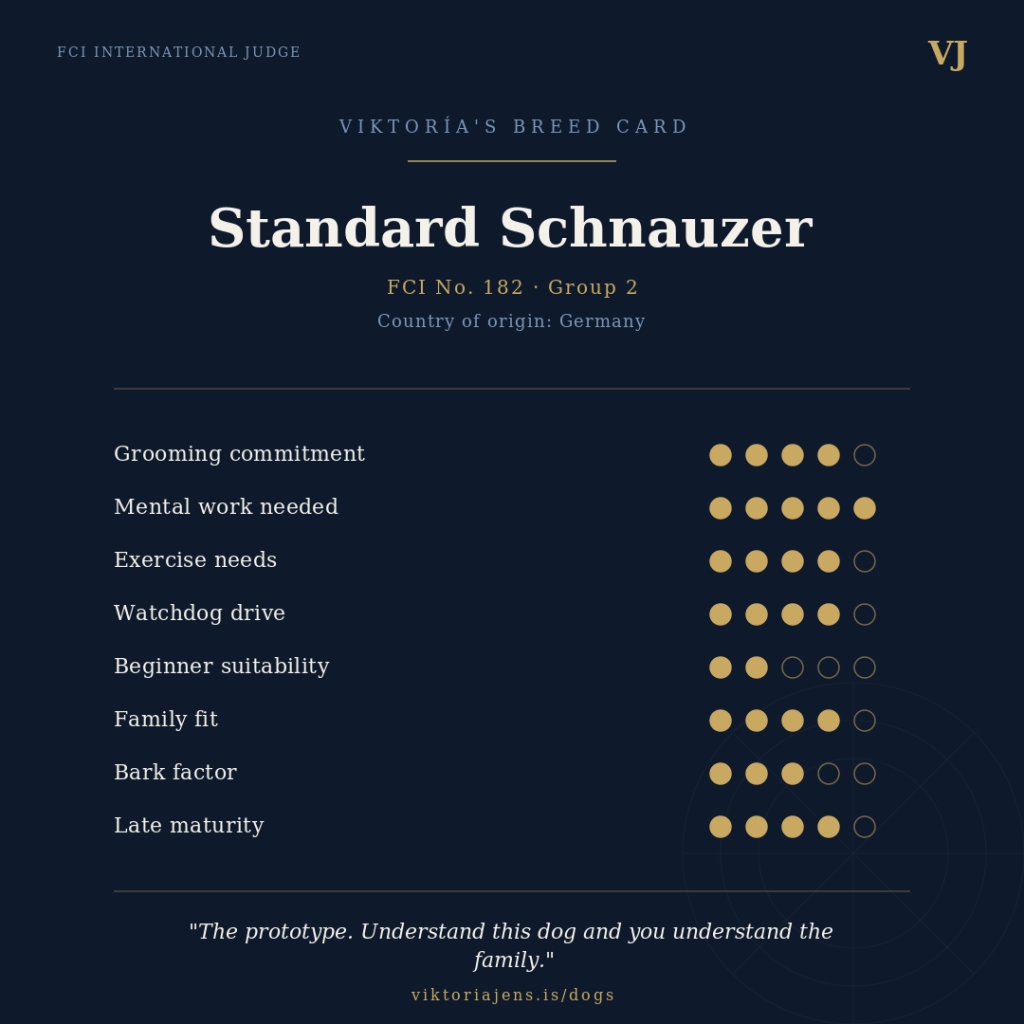
Standard Schnauzer (FCI 182)
Best for: active families with garden access who want a real partnership with a medium-sized working dog. Owners who can offer daily training, mental work and structured exercise. People who want one dog that does everything well — companion, watchdog, hike partner, sport partner — without being either too small or too large.
Tough for: first-time dog owners. Households that confuse calm appearance with low-energy reality. People who want a dog who fits around a busy life with no adjustments.
The honest part: the Standard is the size most people in the dog world quietly recommend to friends and then privately wish they had chosen for themselves. It carries the family’s working temperament fully, in a body that fits a normal home. The reason it is not more popular is partly the breed’s relative rarity and partly that it does not have the visual drama of a Mini in a handbag or a Giant on a leash. People walk past the Standard. People walk past the right answer often.
If you are even considering the family, read this size first. The Standard is the calibration point, and once you understand the Standard you can honestly assess whether you actually want a smaller version or a larger version, or whether the Standard is exactly the dog you should have.
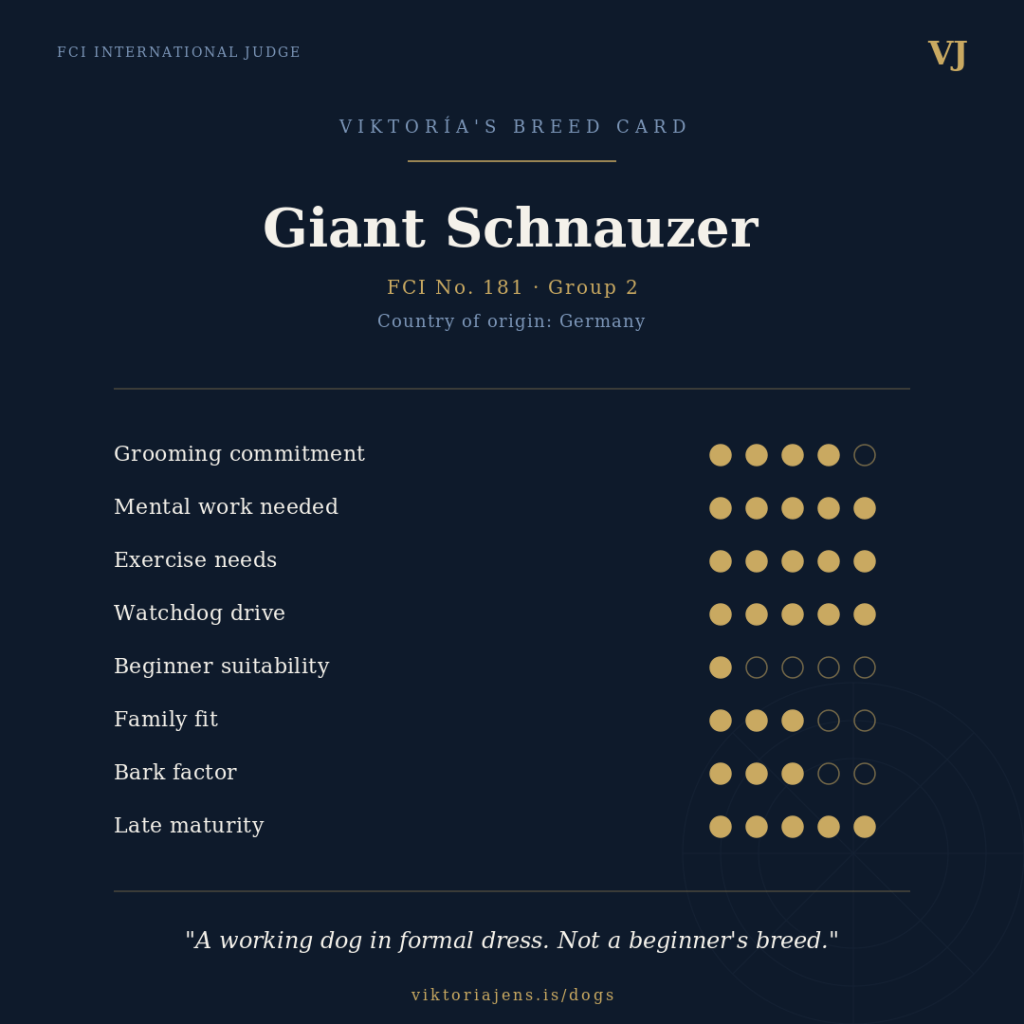
Giant Schnauzer (FCI 181)
Best for: experienced handlers of large working breeds who want a serious partner for sport, working trial, protection sport, or as a deeply involved family dog. People with structure in their lives, time for daily mental and physical work, and the temperament to outlast a strong-willed adolescent dog. Households without toddlers in the early years.
Tough for: anyone hoping for a “bigger Mini.” First-time owners of large working breeds. Households where the dog will spend most of the day alone. People who underestimate the late-maturity reality of Giant breeds.
The honest part: the Giant is impressive, brave, balanced and brilliant when it is in the right hands. It is also a 30-to-40-kilogram working dog with serious guarding heritage and a long, slow maturation that often surprises owners who expected a settled adult by 18 months. Plan for two full years of intentional, structured work before you describe the dog as “easy.” The Giant is not a beginner’s breed. The Giant is the dog you choose after you have raised one or two other working breeds well, and you know what you are signing up for.
The other honest part: the Giant rewards good ownership more than almost any other breed I judge. The bond a well-raised Giant builds with its handler is unusual even by working-dog standards. But that bond is the result of work, not luck.
And the fourth answer: this is not your dog
The hardest, most underrated answer in any breed-selection conversation is “the right dog for you is not in this family.” If you have read this far and the picture forming in your head does not match your daily life, you have already done the most important thing: you have considered the breed honestly before bringing one home, instead of the other way around.
If the issue is grooming, look at smooth-coated working breeds. If the issue is energy, consider Cavaliers, Cockers, or other breeds whose temperament curve is genuinely lower. If the issue is independence and being alone often, talk to a breed club about which breeds tolerate that pattern best — though the responsible answer is often “rethink the alone-time before you choose any dog.”
The right dog is the dog that fits the life you actually live, not the life you wish you lived. A Schnauzer will not pretend the gap does not exist.
Take the quiz
Five questions, an honest answer in under two minutes. The result cards explain what each answer means and what to read next.
What this means before you buy
Before you contact any breeder, do these three things in order. First, take the quiz and read the result card honestly. Second, write down what you would change about your current life to make room for the dog — and only proceed if those changes are realistic for you. Third, contact a breed-club breeder, not a marketplace. Reputable Schnauzer breeders interview their buyers. The good ones will turn you down if the fit is wrong, and that is exactly the breeder you want.
This article concludes the four-part Schnauzer series. The next series will cover the Poodle — using the same Breed Card framework so you can compare honestly across breeds.
One question to leave you with: if a serious Schnauzer breeder asked you, in one sentence, why you want this breed and not another, what would you say — and would your daily life back the sentence up?
The views expressed here are my own. Judges and breeders should always refer to the FCI breed standard as the authoritative reference.
Sources for this article: FCI Standards 181, 182 and 183; Danish Kennel Club (DKK) breed pages; Swedish Kennel Club / SSPK Domarkompendium series; Norwegian Schnauzer Club (NSBK) breeding guidelines; Pinscher-Schnauzer-Klub (PSK / VDH); Internationale Schnauzer Pinscher Union (ISPU); national kennel-club registration data (UK Kennel Club, AKC, SKK, NKK).


Leave a comment