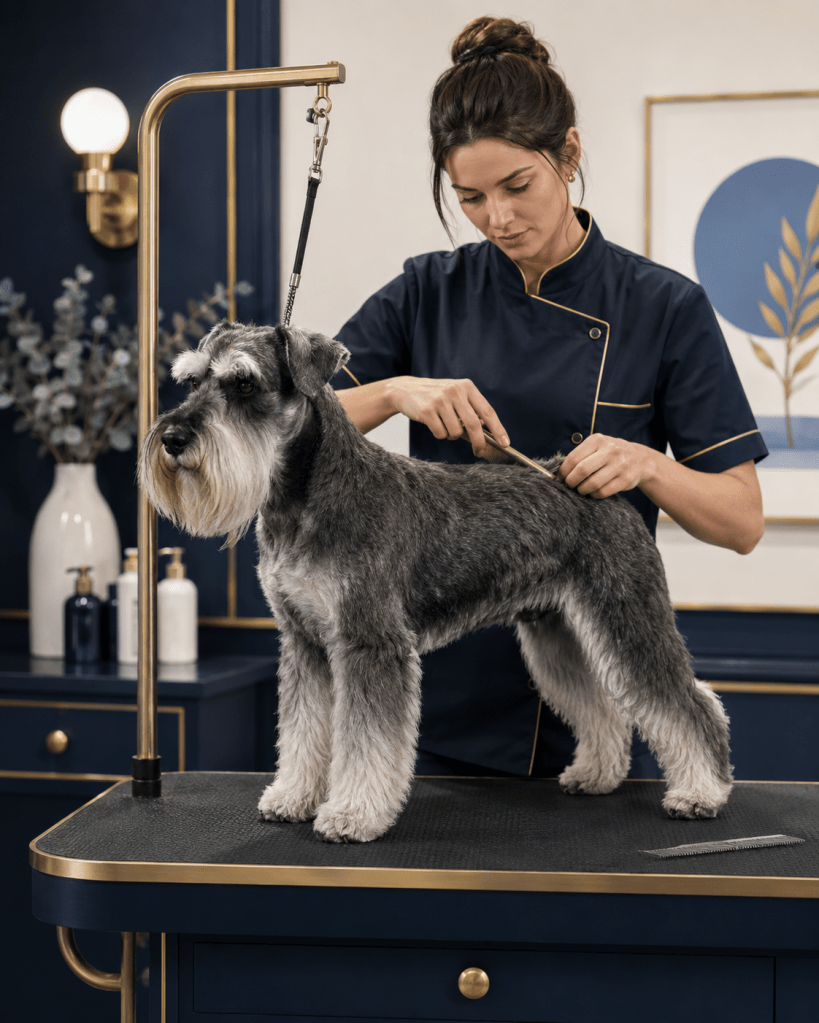
There is one breed family I think about more than any other when I talk about presentation in the show ring, and it is the Schnauzer family. Few breeds reward a skilled groomer with so much visible improvement, and few breeds punish a lazy hand-on examination so thoroughly. A correctly trimmed and stripped Schnauzer can hide an alarming number of structural shortcomings under its furnishings. A judge who only uses the eye, and never the hand, will reward those shortcomings.
This article is the one I would have wanted to read as a young exhibitor and then as a young judge. It is about the difference between presentation and type, what grooming can and cannot do, and the six-step hands-on examination I run on every Schnauzer that comes onto my table.
The principle, before anything else
Grooming can enhance type. Grooming must not create type.
A correct Schnauzer underneath a beautiful trim is the goal — and there are exhibitors who deserve every ribbon they win, because they present a structurally correct dog at its best. An incorrect Schnauzer underneath a beautiful trim is a problem the standard is asking you to find. That is the entire job.
What grooming can legitimately do
Skilled grooming on a Schnauzer is real craftsmanship. Done well, it can:
- Tidy the outline so the eye reads the dog’s natural square build cleanly.
- Bring the coat to the right length to display correct texture and colour.
- Define the eyebrows and beard so the breed’s characteristic expression is visible.
- Show the line of the underchest, neck and topline as they actually exist.
- Remove dead coat through hand-stripping. The FCI standard describes a coat texture — harsh, wiry, dense, with body — that is only naturally maintainable by stripping; clipping cuts each hair mid-shaft and, over generations, softens the very texture the standard is asking for. The standard does not name the method, but it describes the result that only the method produces.
None of those is dishonest. They are the exhibitor’s job. The line is crossed when the trim does the work the structure failed to do.
What grooming can hide — and what your hand will find
Here is the list I use mentally as I go down the dog. Each row pairs a common cosmetic illusion with the hands-on check that exposes it.
| What grooming can hide | What your hand should check |
| Weak forechest | Place a finger on the prosternum under the chest furnishings — is there real bone there, or only hair? |
| Short neck or upright shoulder | Trace the actual line of the neck from occiput to withers; check shoulder layback by feeling the scapula angle, not by reading the coat shape |
| Poor topline | Run a flat hand from withers to croup; topline shape under the comb tells you nothing if the dog dipped under the hand |
| Weak underjaw | Cup the muzzle with thumb and finger under the beard — is the underjaw broad and square, or has the beard hidden a snipey muzzle? |
| Round or light eye | Lift the brow trimming and look at the actual eye shape, set and colour |
| Soft coat texture | Bury your fingers in the jacket; the outer hair should resist the hand and feel wiry, not soft |
| Poor leg structure | Run thumb and finger down each leg from elbow to pastern; scissored furnishings can fake straightness that bone does not have |
| Lack of substance | Lift the dog’s foreleg gently and feel the bone weight; substance is not optional in Schnauzers |
If any of those checks fails, the grooming was the lipstick and the dog was the structural truth underneath.
The proportions to calibrate against, before you read any individual dog
The Schnauzer family is built on a small set of proportional relationships that hold across all three sizes. Memorise these and your eye stops being fooled by grooming.
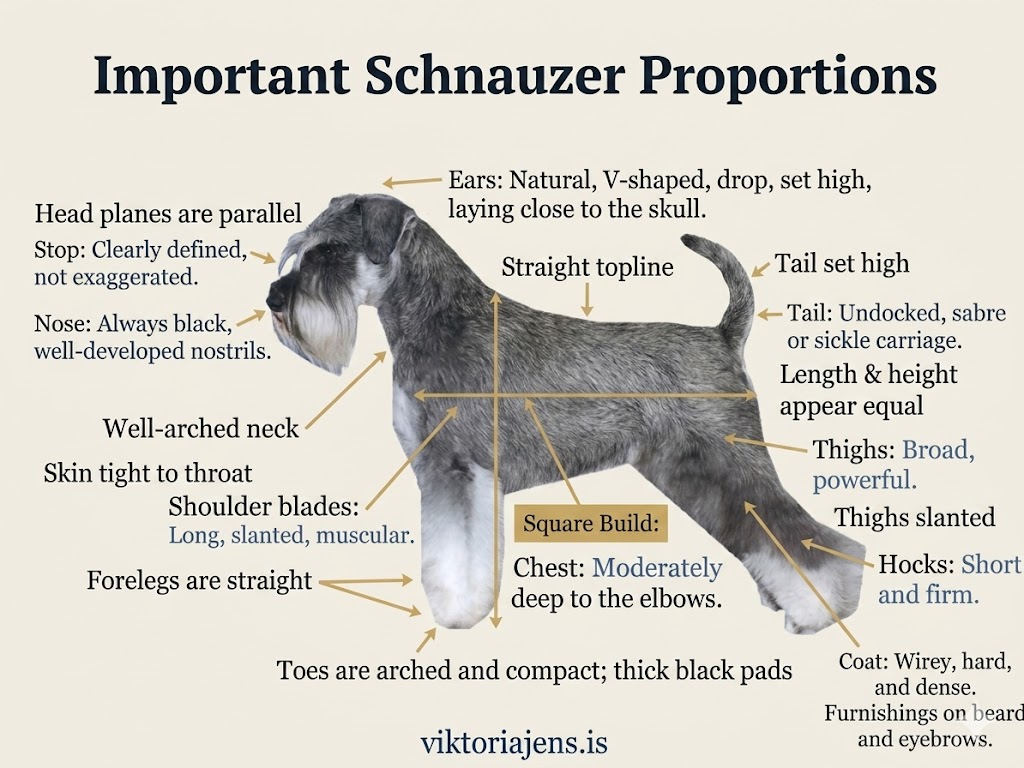
The body is square. The length of the body, measured from the point of the shoulder to the point of the buttock, equals the height at the withers. This is the single most important proportion in the breed. A Schnauzer should fit inside a square. Long body is one of the most common faults in the Standard Schnauzer specifically.
The chest is half the height. The depth of the chest, measured from the withers to the lowest point of the brisket, is approximately one-half of the height at the withers. The chest should reach to the elbows — no higher, no lower. A shallow chest reads as racy and pulls the dog out of working type; an over-deep chest reads as heavy and makes the legs look short.
The head is roughly half the length of the topline. Measured from the occiput to the tip of the nose, the head is approximately equal to half the length from withers to set-on of tail. That gives the breed its characteristic in-proportion expression — never small-headed, never gross-headed.
The skull and muzzle are equal. The head is divided into two halves at the stop: the skull (from the occiput to the stop) and the muzzle (from the stop to the tip of the nose) are of approximately equal length. The two planes — top of skull and top of muzzle — are parallel, separated by a stop that is clearly defined but never exaggerated. This is what gives the Schnauzer its rectangular, blunt-wedge head. Snipey muzzles, over-deep stops, and apple-domed skulls are all faults.
The head sits on a neck of moderate length. The neck flows cleanly from the withers, arched gently, never short and stuffy and never overlong and ewe-necked. As a working measure, the neck should be roughly equal in length to the head.
When you stand back from a Schnauzer at the stand, your eye should run cleanly through five rectangles of approximately consistent proportion: skull, muzzle, neck, body, and the front leg from elbow to ground. If any one of those reads as visibly out of scale with the others, the dog has a proportion problem that grooming will not fix.
Common proportion faults by size
The proportions above are the same for all three Schnauzers. The faults against those proportions cluster differently by size, and it pays to know which way each size tends to drift:
| Proportion | Miniature risks | Standard risks | Giant risks |
| Square outline | Slightly short or cobby; too compressed in body | Long in loin; loss of square outline is the most common Standard fault | Tendency to length, sometimes from over-substance pulling proportion out |
| Chest to elbow | Shallow chest, racy-looking | Shallow or barrel-sprung | Over-deep chest, heavy front |
| Head-to-body | Fine-boned head, slightly small for the body | Soft expression; head can read plain | Coarse, heavy skull; mastiff-like |
| Skull-to-muzzle | Snipey muzzle; round eye that softens expression | Plain head; indistinct stop | Over-deep stop; heavy underjaw; coarse muzzle |
| Neck length | Stuffy short neck | Ewe-neck, or thin neck on a long body | Short and thick, set into heavy shoulders |
A Mini that fails its proportions slips toward toy-dog cuteness. A Standard that fails its proportions slips toward generic medium-sized terrier length. A Giant that fails its proportions slips toward Dobermann elegance on one side or mastiff coarseness on the other. The size determines the failure mode, not whether the proportions still apply.
The six-step hands-on examination
This is the order I work in on my table. It takes around forty seconds per dog when you have done it a hundred times. The order matters because it builds a complete picture before any single fault dominates the impression.
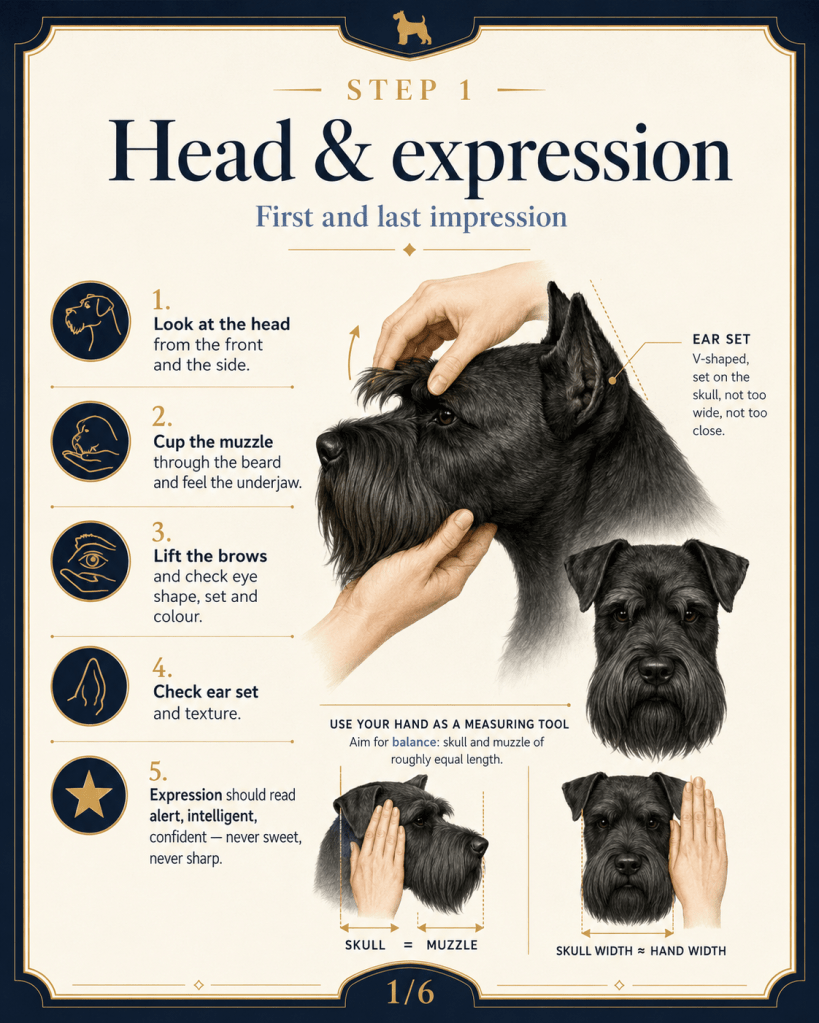
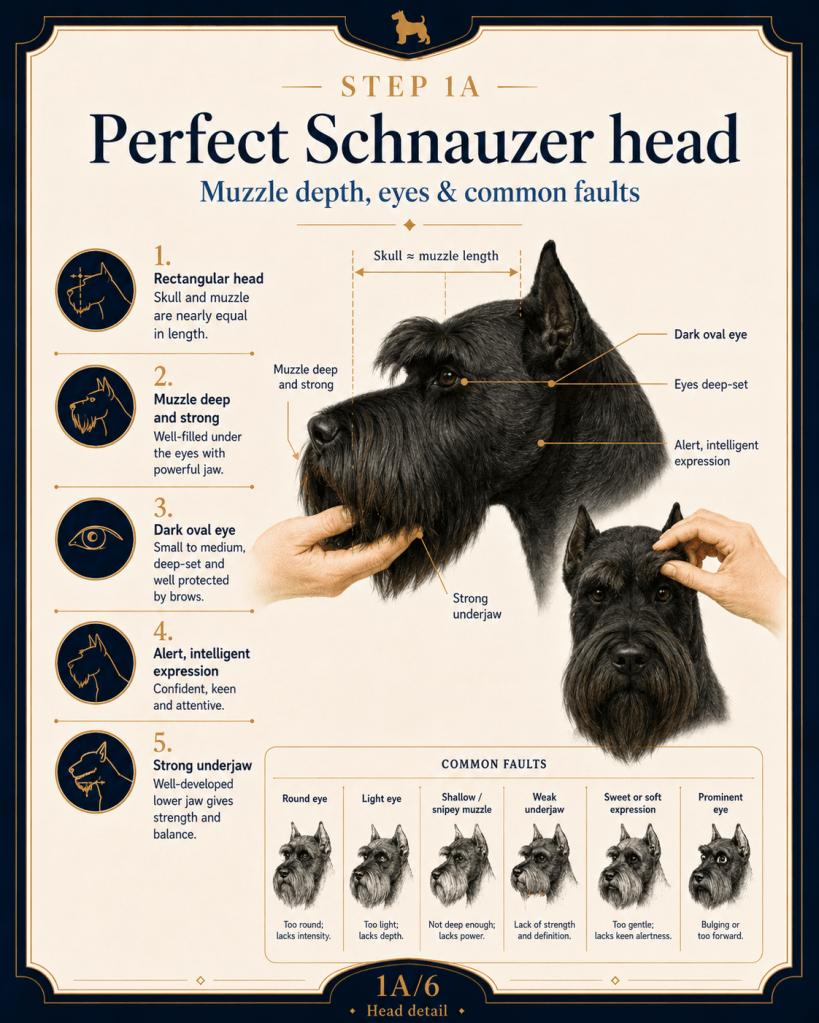
Step 1: Head and expression — first and last impression. Look at the head from the front and the side. Then put your hand on it. Cup the muzzle through the beard and feel the underjaw. Lift the brows and look at the eye shape, set, and colour. Check ear set and texture. The Schnauzer expression should read alert, intelligent, confident — never sweet, never sharp.
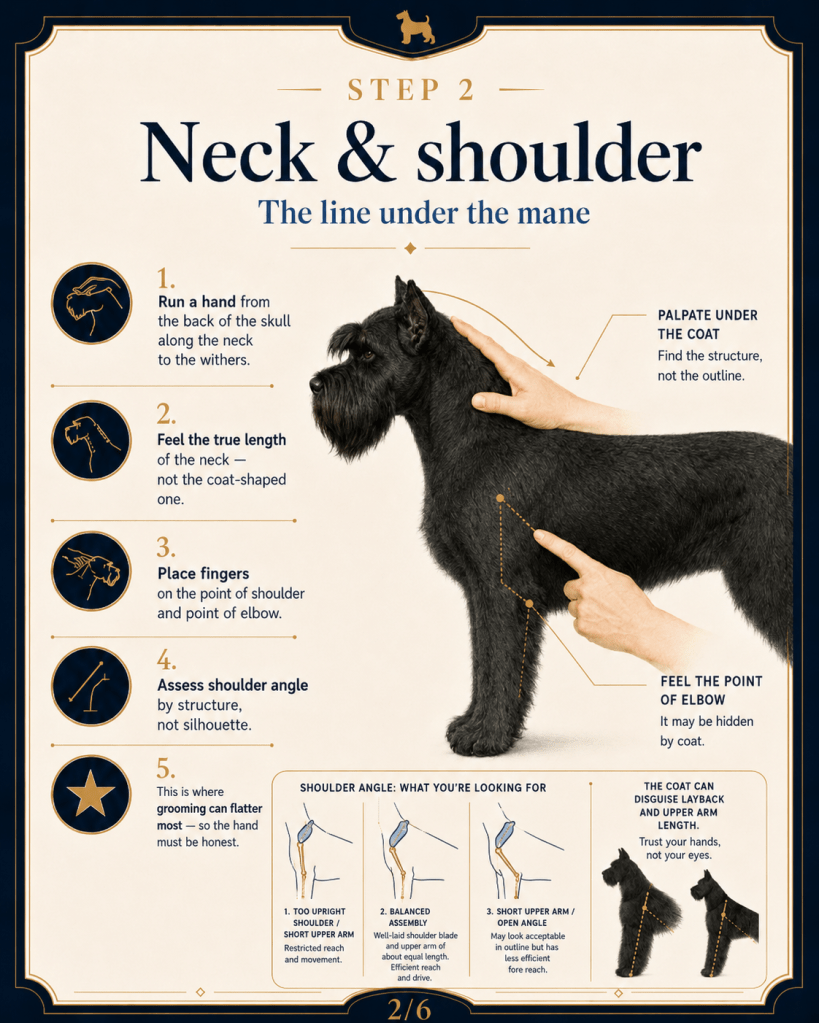
Step 2: Neck and shoulder — the line under the mane. Run a hand from the back of the skull along the neck to the withers. Feel the actual length of the neck, not the coat-shaped one. Then place fingers on the point of the shoulder and the point of the elbow and assess the shoulder angle by structure, not by silhouette. This is where a great groomer can flatter the dog the most, so this is where the hand has to be most honest.
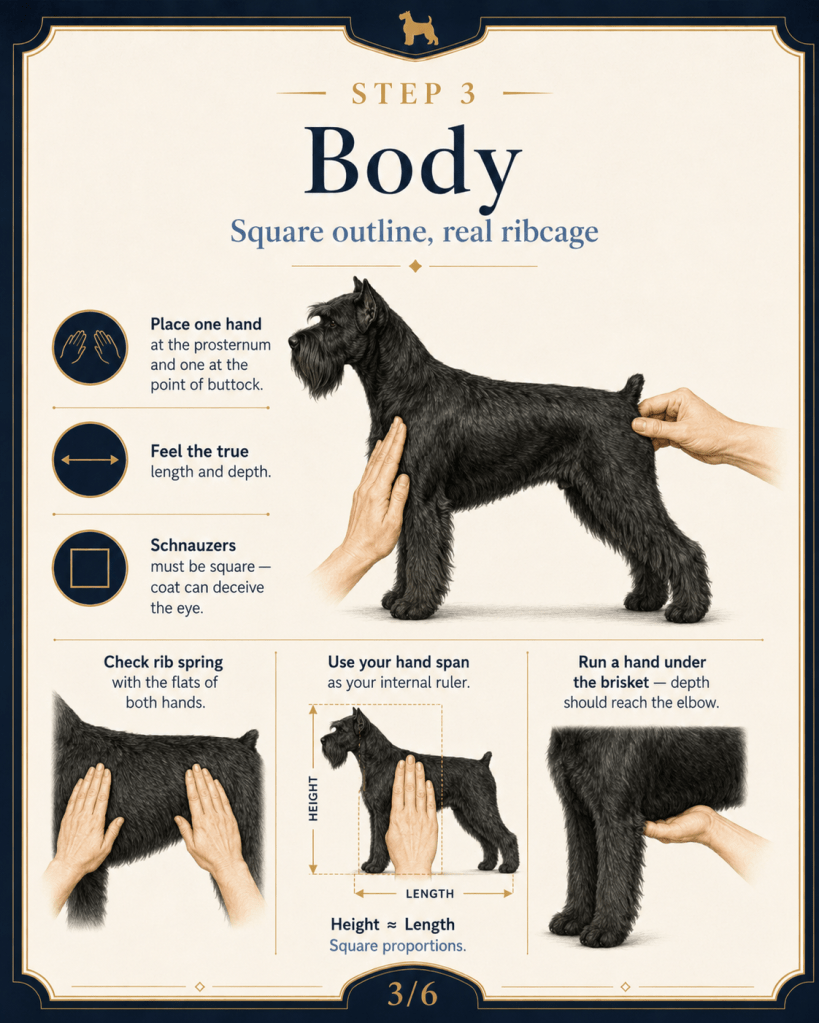
Step 3: Body — square outline, real ribcage. Place one hand at the prosternum and one at the point of the buttock. Feel the actual length and depth. Schnauzers must be square; coat can lie in ways that make a long dog look square or a short dog look stretched. Check rib spring with the flats of both hands on the sides. Run a hand under the brisket — depth should reach the elbow.
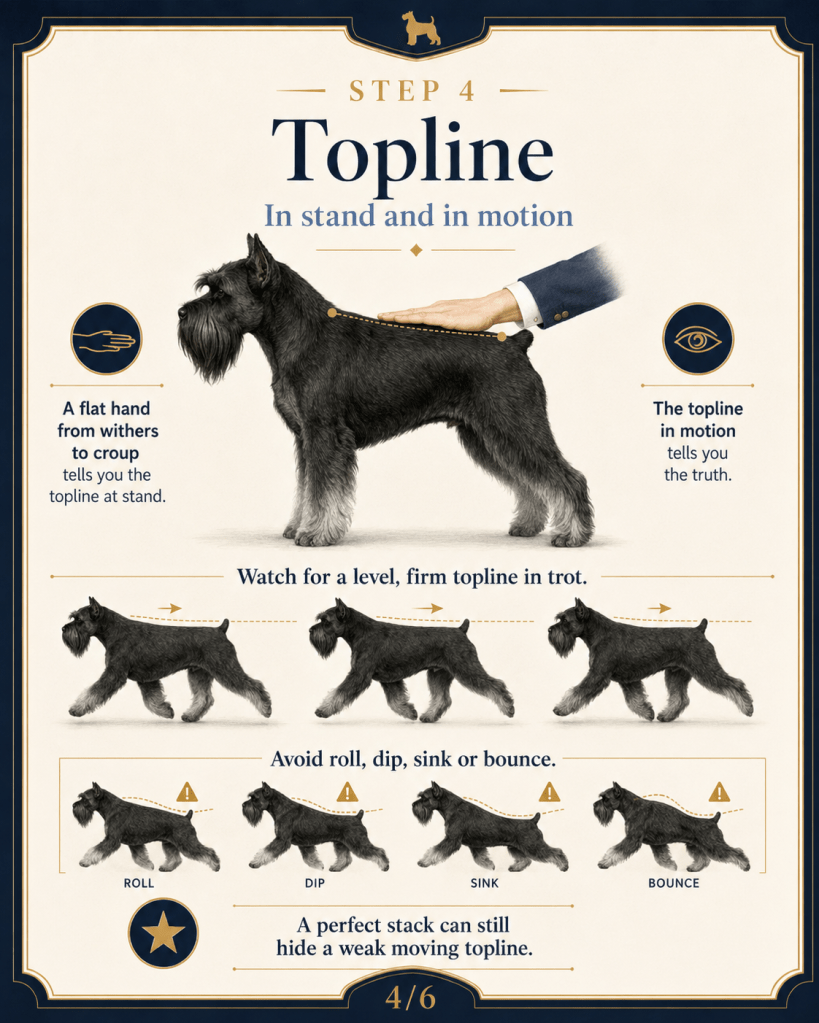
Step 4: Topline in stand and in motion. A flat hand from withers to croup tells you the topline at stand. The topline in motion tells you the topline truthfully. Watch the dog trot and look for a level, firm topline that does not roll, dip, sink or bounce. Schnauzers can be sculpted into a perfect stack and still bounce in motion.
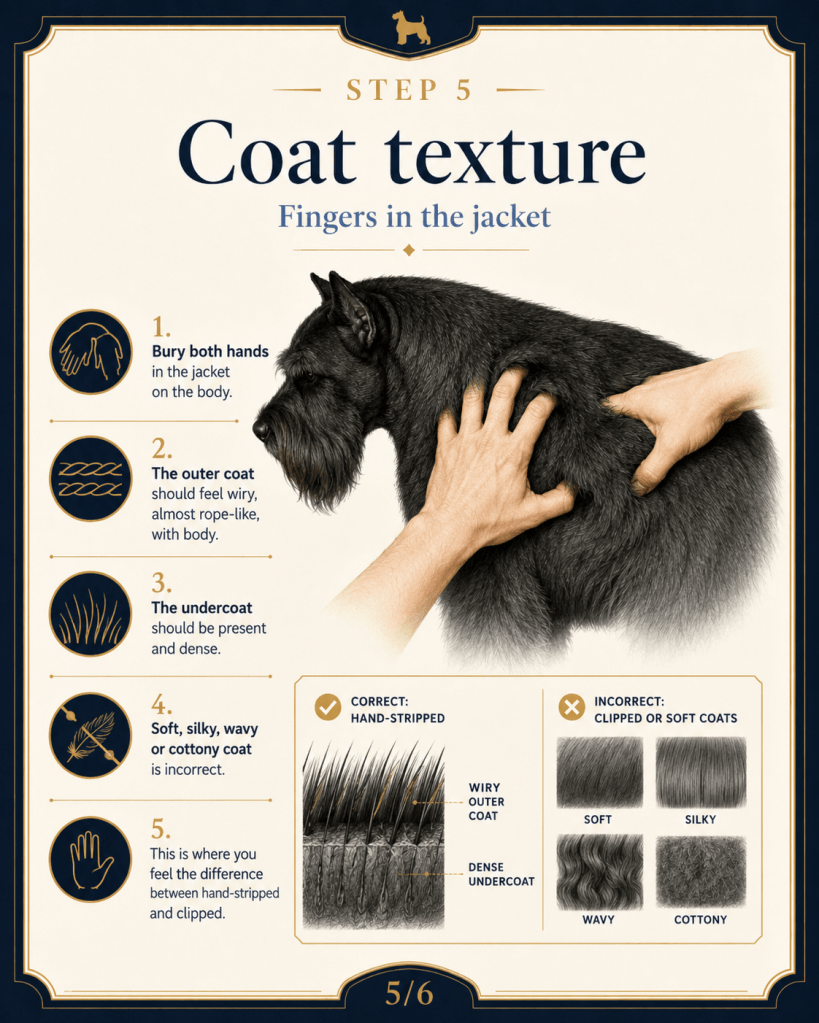
Step 5: Coat texture — fingers in the jacket. Bury both hands in the jacket on the body. The outer coat should feel wiry, almost rope-like, with body. The undercoat should be present and dense. Soft, silky, wavy or cottony coat is incorrect, regardless of how it is presented. This is where you find the difference between a hand-stripped jacket and a clipped one.
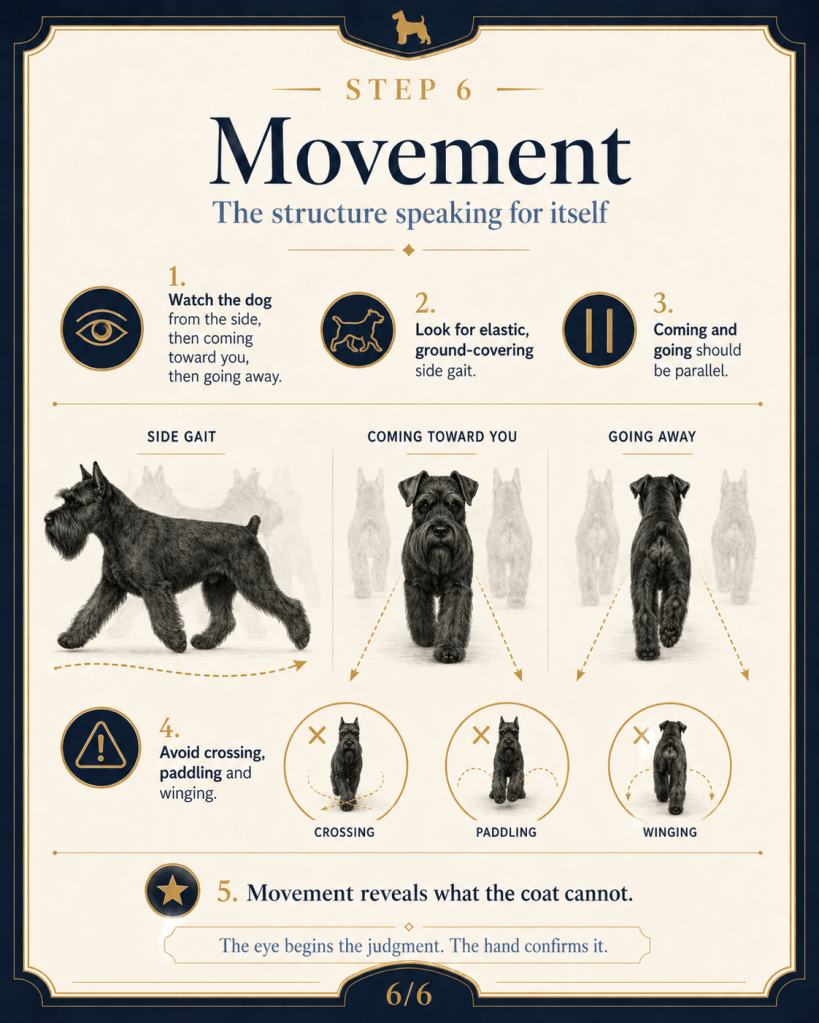
Step 6: Movement — the structure speaking for itself. Watch the dog from the side, then coming toward you, then going away. The Schnauzer should move with elastic, ground-covering side gait, parallel coming and going, no crossing, no paddling, no winging. Movement reveals the things the coat cannot.
Movement is where the coat stops mattering
Of all six steps, movement is the one I trust most when I have a tight class. A judge can be misled at the stand because grooming, stacking and handler skill all converge there. A judge cannot be misled in motion. A long body shows up in motion. A weak rear shows up in motion. A close or crossing front shows up in motion. The coat does not move with the bones; the bones move on their own.
When two dogs are stacked side by side and both look correct, ask the steward for one more lap of the ring. The second look is where the truth is.
A note on grooming culture: America versus Europe
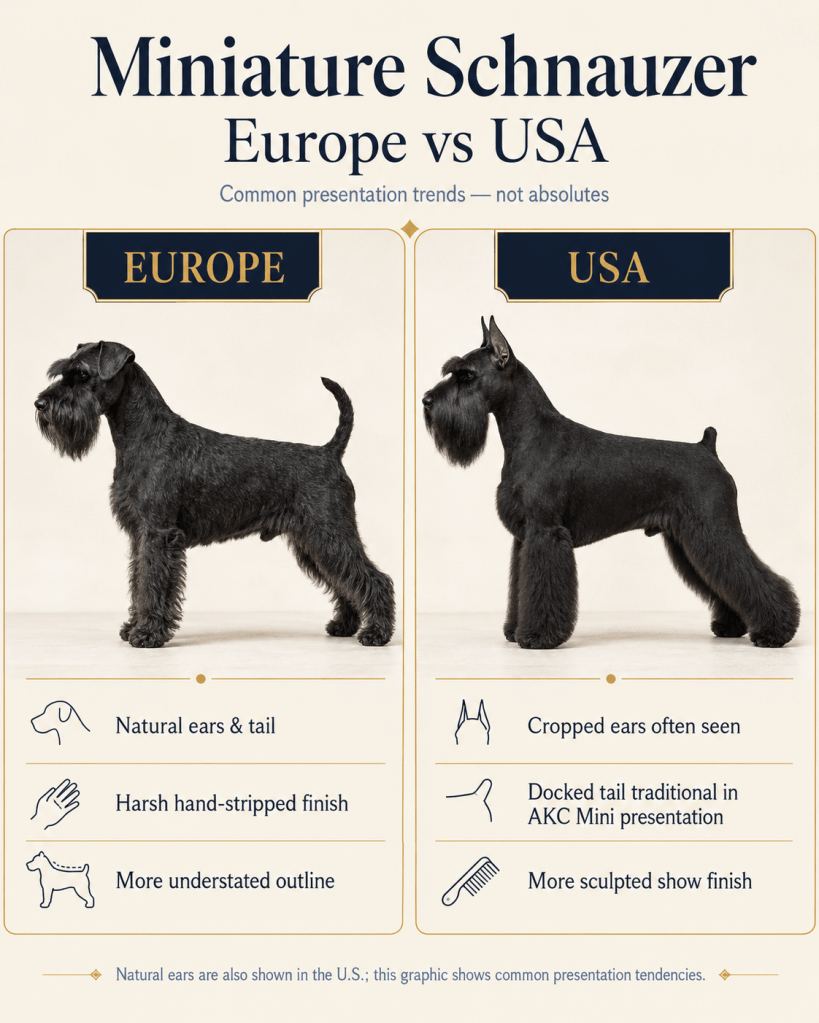
If you judge across registries, the same Schnauzer can look different depending on where it was prepared for the ring. Worth knowing the dominant grooming traditions before you walk in.
American grooming culture — visible at AKC shows and in published American grooming material — tends toward heavy sculpting. Heads are shaped with scissors into a more architectural outline; the eyebrows are cut into pronounced V-shapes; the beard is squared off and held with product; the furnishings on the legs are scissored into pronounced columns. The intention is a polished, almost engineered silhouette that reads from across the ring. American Miniatures in particular are often presented with more dramatic head and forechest furnishings than their European counterparts.
European and FCI grooming culture — particularly in Germany, the Nordics and Italy — leans toward the dog as a working animal honestly presented. Hand-stripping is more openly required and assumed in serious show preparation. Scissoring is more restrained; the dog’s actual silhouette under the hand-stripped jacket is what the judge expects to see. Nordic kennel club culture in particular emphasises natural presentation through the Breed Specific Instructions framework, which explicitly cautions judges against rewarding exaggerated grooming.
Why this matters for the judge: if you trained in one tradition and walk into the other, you can be biased without realising it. An FCI judge looking at a heavily sculpted American Mini can be impressed by an outline that the FCI tradition would read as overdone; an American judge looking at a Nordic-prepared Schnauzer can read the more natural silhouette as undergroomed. The fix is the same fix as always — go through the coat with your hands and judge the dog underneath the trim. Both presentation cultures produce both correct and incorrect dogs; neither tradition holds a monopoly on type.
Why this matters for the exhibitor: if you are showing a dog imported or bred from a different presentation tradition, ask the breeder or a local handler how to prepare the dog for the ring you are entering. The dog’s structure does not change; the presentation expectations do.
Chalk, colour enhancement and dye — reading the coat under the cosmetics
The other thing that can disguise a Schnauzer in the ring is product on the coat. The FCI rules generally prohibit artificial colouring of show dogs; chalk used as a cleaning agent during preparation is tolerated only when it is brushed out completely before judging. In practice, what you find on the ring table is a spectrum:
- Chalk in the beard and on white legs — used to whiten and to absorb oil during preparation. Common; usually meant to be brushed out; often not entirely brushed out.
- Black chalk or pigmented product on a black coat — used to deepen the colour of a faded, sun-bleached or rusting black. Less common but real.
- Pigmented sprays on pepper and salt — used to deepen contrast or even out distribution.
- Hair dye — explicitly prohibited and rare in clean show culture, but it happens.
A judge cannot stop someone from preparing a dog with product. A judge can read the coat carefully enough that the cosmetics do not change the placement. A few checks I use:
Rub the back of your hand against the coat. Run the back of your hand firmly along the back, the flank and the chest. Pull your hand away and look at the skin. Black or grey transfer on your hand is chalk or pigmented product. White transfer is whitening chalk. Either way, the dog has been finished with cosmetics that were not entirely brushed out, and you now know how much of the colour you are seeing is the dog.
Check the inside of the ears, the lips and the underside of the chin. Chalk and powder collect in folds and creases. If you see a fine dust along the lip line or behind the ear that the rest of the body does not show, the coat above it has been chalked.
Check the roots, especially on a black dog. A dyed coat shows colour to the very tip of the hair but lighter or undyed colour close to the skin where new growth has come in. Part the coat at the shoulder and look at the hair closest to the skin. If the root is markedly lighter than the visible coat, the dog has been coloured.
Check the skin pigmentation under the colour. A correctly-pigmented black or pepper-and-salt Schnauzer has dark skin under the dark areas. Lift the coat and look at the skin tone. A dog showing dyed black coat with pale or pink skin underneath is a dog whose colour is on the outside only.
Watch the dog when it shakes or when you handle it. A heavily-chalked dog throws a small visible cloud when it shakes off. A heavily-product-set jacket leaves residue on the table mat. These are honest signals.
The presence of cosmetics is not, on its own, a reason to drop a dog in placement. The standard rewards correct structure, type and movement, all of which exist independently of what is on the coat. But cosmetics tell you to discount the colour impression and judge the dog the cosmetics were trying to flatter. The dog you reward should be correct without the product, not because of it.
Why hand-stripping is part of breed type, not just grooming
This is a point I would not have understood as well as I do now without conversations with serious Schnauzer breeders in three countries. Hand-stripping is not only a presentation choice. It is the maintenance method that preserves the coat the standard describes. A line of Schnauzers that is hand-stripped consistently across generations holds its harsh texture; a line that is clipped consistently slowly drifts toward softer coats, because nothing is selecting against the soft coat in the breeding decisions. A judge who can only assess scissored coats is a judge who has lost a real lever for protecting the breed.
This is also why a beautifully groomed but clipped Schnauzer can win in a soft ring and be quietly damaging the gene pool at the same time. The reward signal goes to the wrong trait.
The signature line
A beautifully groomed Schnauzer should still be a correct Schnauzer when your hands go through the coat.
Hold every ring decision against that sentence. If the answer is yes, reward the dog. If the answer is no, do not let the trim change your mind.
What this means for the three audiences
For the judge: never decide a Schnauzer class on silhouette alone. The hands have to confirm what the eye has suggested, and the movement has to confirm what the hands have read. If the three readings disagree, the dog the hands and the movement describe is the real dog.
For the exhibitor: present the dog you actually have. Skilled presentation is welcomed. Presentation that exists to disguise structural shortcomings is a short game; the better judges find it, and the better breeders see through it. There is no long-term reputation in showing a dog whose grooming exceeds its construction.
For the breeder: if you only ever clip, you cannot honestly assess what you produce. Hand-strip at least one dog from each litter through to maturity. You will see what you are actually breeding.
Next in this series: Which Schnauzer Size Is Right for You — and Which One Is Not — the honest ownership guide by size, with the quiz that answers the same question in five minutes.
One question to leave you with: the next time you watch a Schnauzer class, count how many of the dogs you would still place in the same order if you could only judge by hand and by movement, and not by the coat at all. The number you arrive at says something about the ring you are in.
The views expressed here are my own. Judges and breeders should always refer to the FCI breed standard as the authoritative reference.
Sources for this article: FCI Standards 181, 182 and 183; Swedish Kennel Club / SSPK Domarkompendium for Schnauzer, Dvärgschnauzer and Riesenschnauzer; Nordic Kennel Union Breed Specific Instructions (BSI); Pinscher-Schnauzer-Klub (PSK / VDH) breeding regulations.
 Viktoría Jens
Leave a comment