People look at a Schnauzer and see a haircut. Judges and serious breeders look at a Schnauzer and see a working garment that happens to also be a haircut. The difference matters because the harsh outer coat, the dense undercoat, the banded hair pattern in pepper-and-salt and the deep pigmentation of a true black are not cosmetic features. They are the breed’s working CV.
This article walks through what the coat is, what the four FCI-accepted colour patterns actually look like, why hand-stripping preserves what scissoring fakes.
Why the harsh coat exists in the first place
The Schnauzer was bred as a southern German farm and stable dog. The harsh outer coat sheds rain, dirt and small thorns; the dense undercoat insulates against Bavarian winter; the eyebrows and beard protect the eyes and muzzle when the dog confronts vermin in tight spaces or pushes through cover. None of those traits are decorative. They are the reason the dog could do its job all day, in any weather, without coming apart.
This matters for everyone who handles the breed. For the judge: a soft, wavy or silky coat is not just an aesthetic fault, it is a functional fault. For the breeder: breeding for an easier-to-groom coat slowly breeds out the texture the standard demands. For the owner: a Schnauzer with the correct harsh coat sheds far less than people expect — but only if it is hand-stripped, not clipped.Hand check: part the coat with your fingers. The outer hair should feel wiry, almost rope-like, with body. Underneath you should find a softer, dense undercoat. If the outer coat feels soft to the touch and lies flat without resistance, the texture is not correct, regardless of how the dog photographs.
The four FCI-accepted colours, and what each one actually looks like
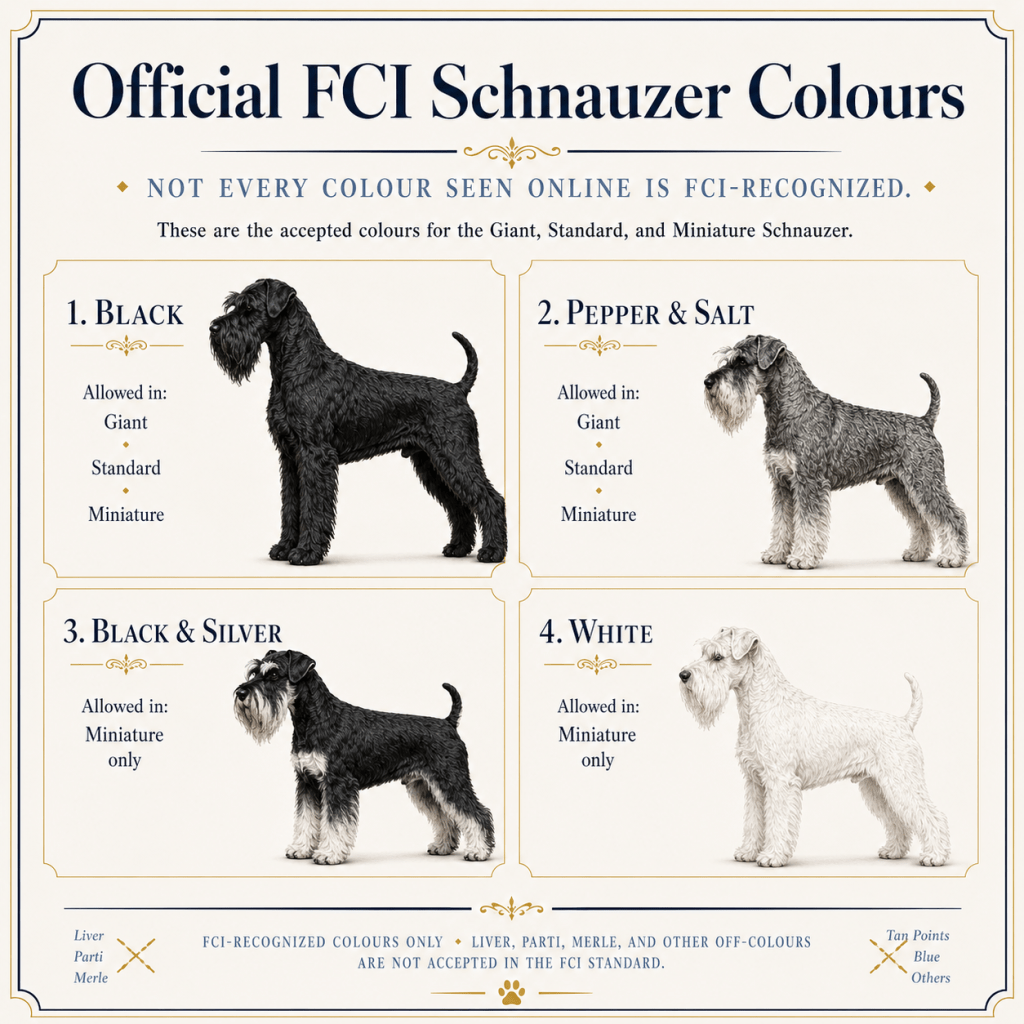
The FCI recognises different colour ranges depending on the size. The full picture across all three Schnauzers is:
| Colour | Miniature (FCI 183) | Standard (FCI 182) | Giant (FCI 181) |
| Pepper and salt | Accepted | Accepted | Accepted |
| Pure black with black undercoat | Accepted | Accepted | Accepted |
| Black and silver | Accepted | — | Accepted (since 2021) |
| White | Accepted | — | — |
A few things that surprise people:
- The Standard Schnauzer comes in only two colours under FCI — pepper and salt, and pure black. There is no black/silver Standard, no white Standard.
- The Giant Schnauzer’s black and silver variety is a recent addition, granted separate CACIB status from July 2021. Many ringside spectators and even some judges still think of Giants as primarily black.
The white Miniature is FCI-accepted but AKC-disqualified, which is the cleanest example of how the same breed diverges across registries.
Pepper and salt — the banded coat
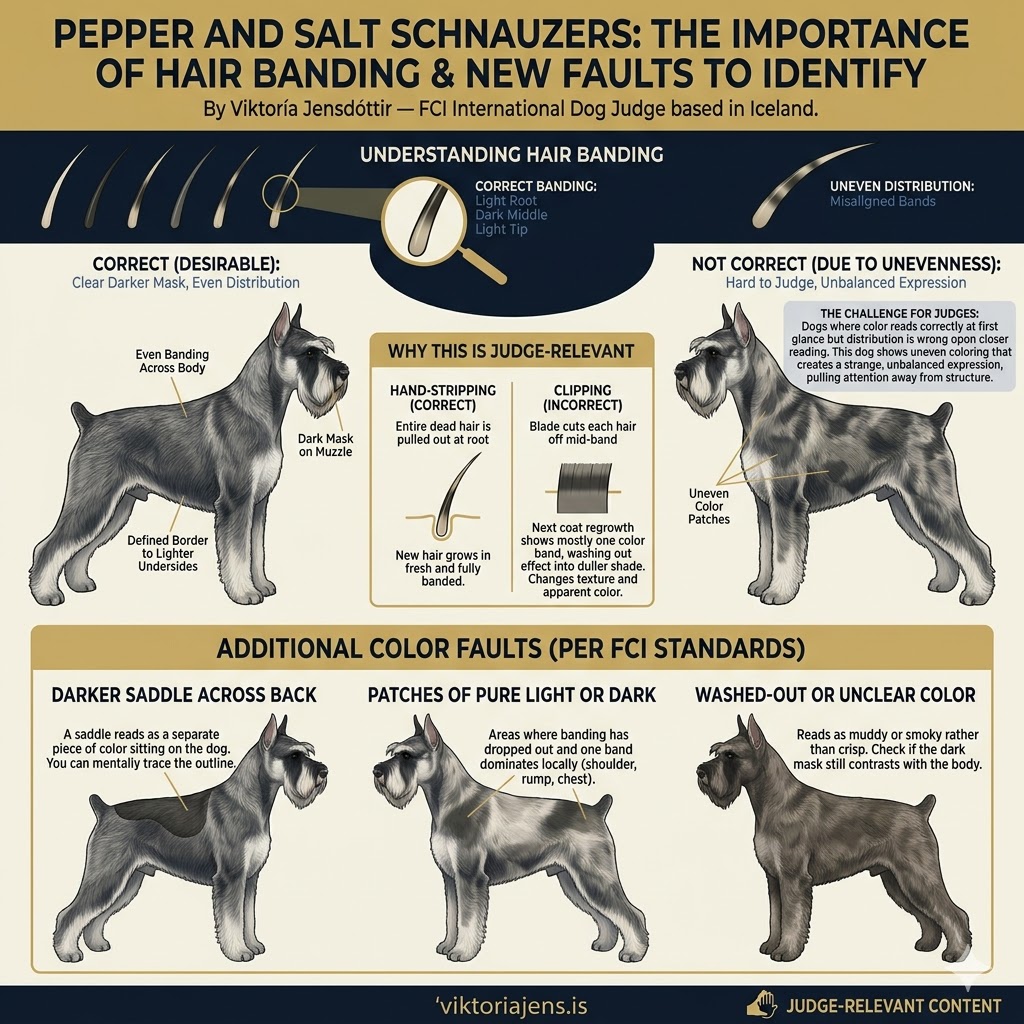
Pepper and salt is not a mixture of light and dark hairs. Each individual hair is banded — light at the root, darker through the middle, light again at the tip — and the visual effect of a coat full of those banded hairs is the silvery, peppered impression we recognise. The same dog can read as “light pepper and salt” or “dark pepper and salt” depending on which band the eye sees most. The standard asks for a clear darker mask on the muzzle, even distribution across the body, and a defined border between the body colour and the lighter chest, throat, eyebrows, beard and undersides.
Why this is judge-relevant: clipping a pepper-and-salt Schnauzer with a blade cuts each hair off mid-band. The result is that the next coat regrowth shows mostly one colour band, washing out the pepper-and-salt effect into a duller, flatter shade. Hand-stripping pulls the entire dead hair out at the root, so the new hair grows in fresh and banded. Clipping does not just change the texture; it changes the apparent colour.
When Pepper and salt is hard to judge
The hardest pepper-and-salt dogs to judge are not the obviously washed-out ones or the obviously dark ones. They are the dogs where the colour reads correctly on first glance but the distribution is wrong on closer reading.
I had this exact situation in the ring with a Standard Schnauzer. The pepper-and-salt distribution was so uneven that it caught the eye the moment the dog walked in — and the unevenness sat in a way that gave the dog a strange, unbalanced expression. Structurally there was a sound animal underneath, but the colour fault was the first thing the eye landed on, and it kept pulling attention away from what was correct about the dog.
The FCI standard for pepper and salt asks for even distribution of the colour and identifies a few specific faults: too light or washed-out colour, unclear colour, black saddle, and patches of one colour. Each of these is a different judging problem and should be read as a different signal.
Acceptable variation: a correct pepper-and-salt dog can read as a lighter or darker shade overall, depending on which band of the hair the eye is reading most. The dark mask on the muzzle is expected. Slight gradation is normal — the topline often appears a touch darker than the flanks because the coat lies thicker there. None of that is a fault. The whole dog should still read as one coherent pepper-and-salt animal.
The faults to actually call:
A darker saddle across the back, with markedly lighter sides and undersides, is not the same as a slightly thicker coat on top. A saddle reads as a separate piece of colour sitting on the dog. The standard names this directly. If you can mentally trace the outline of the saddle as a shape, it is a saddle, and it is a fault.
Patches of pure light or pure dark — areas where the banding has dropped out and one colour band dominates locally — are also a named fault. These often appear on the shoulder, the rump, or the chest. They tell you the colour genetics in that line are not stable, which matters more for breeders than for ring placement on the day, but as a judge they should weigh in your final order.
Washed-out or unclear colour across the whole dog is the third pattern. This usually reads as muddy or smoky rather than crisp pepper and salt. It is harder to call quickly because the dog can still look pleasant from a distance. The honest test is whether the dark mask still contrasts with the body, and whether the eyebrows and beard still sit clearly defined against the surrounding coat.
The hand-check that exposes uneven distribution. Standing back tells you the overall impression. Hands on the dog tell you the truth. Part the coat with your fingers in three different places — the shoulder, the mid-back, the croup — and look at each section in turn:
- Are the individual hairs banded in each spot, or has one band dominated locally?
- Is the proportion of dark band to light band roughly the same across all three spots?
- Does the undercoat colour stay consistent across the body, or does it shift?
If the banding pattern changes meaningfully from spot to spot, you are looking at uneven distribution, not a thicker top coat. That is the moment to weigh the colour fault into your placement, especially if a competing dog in the same class shows clean, consistent distribution end to end.
One judging principle to leave with this: never let an uneven distribution lift a structurally weaker dog over a correct one — but equally, never let a beautifully presented but unevenly coloured Schnauzer rest unchallenged in your placements simply because it presented well. The standard names the fault for a reason. Calling it is part of the job.
True black with black undercoat
A correct black Schnauzer is black to the roots, including the undercoat. Black noses, lips, eye rims. Pigmentation is everything. Sun, age, diet and over-clipping can fade a black coat to a rusty brown — what’s called “rusting” — and a judge needs to distinguish a faded coat (a presentation issue) from genuinely incorrect pigmentation (a structural issue). They are not the same fault. One is fixable; the other is hereditary.
Black and silver — the markings matter
In a correct black and silver Mini or Giant, the body is true black with sharply defined silver-white markings on the eyebrows, muzzle/beard, throat, chest (often with two distinct chest triangles), forelegs below the elbow, around the anus and on the hindlegs. The contrast should be clean. Muddied markings, smudged borders, or markings so flashy that the dog reads more like a different breed are all faults the standard describes. Indistinct chest triangles is a colour-pattern fault to watch for.
White Miniature
White is a Schnauzer first and a colour second. The dog must still have correct harsh coat texture, correct pigmentation on nose, lips and eye rims (black, never liver or pink), correct expression, correct construction. A “fluffy white toy” is not an FCI white Miniature, however well it sells on social media. Patchy coat in white Minis is a fault explicitly listed in the standard.
“Rare colours” — and why responsible breeders do not chase them
You will see merle, parti-coloured, liver/chocolate, blue-eyed and lilac Schnauzers marketed online as “rare,” usually at premium prices. These colours are not in the FCI standard for any Schnauzer size. They typically arise either from outcrossing or from genetic variants that bring health risks of their own (merle is the most documented example). The FCI breed standard introduction states clearly that a standard exists to describe and protect the true type of the breed; chasing colours outside the standard pulls breeding away from that type.
A simple rule for buyers: if a breeder leads with the colour rather than the temperament, the health testing or the parents’ working/show qualifications, the priority order tells you what you need to know.
Hand-stripping versus clipping — what the judge sees
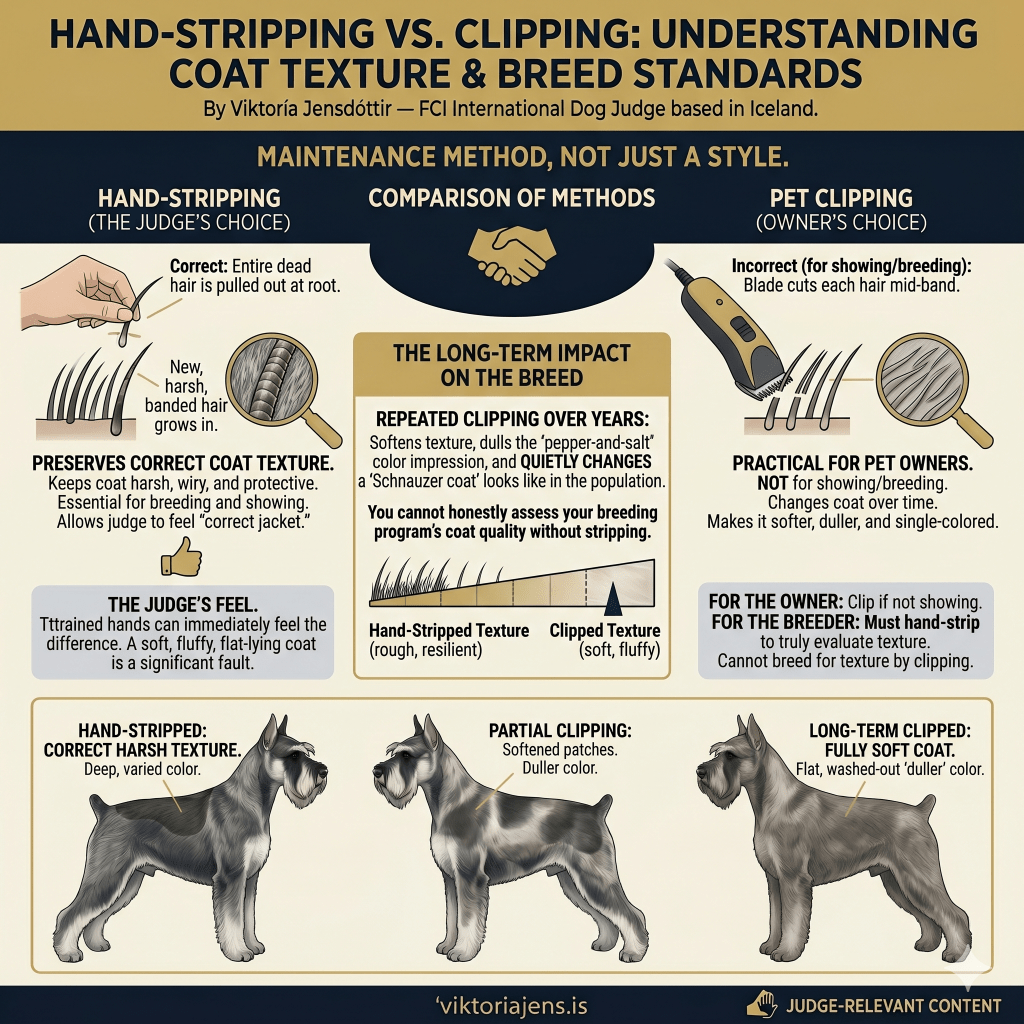
Hand-stripping is not just a grooming style. It is a maintenance method that preserves the coat the breed standard describes. Pet clipping is a practical choice for owners who do not show, but repeated clipping over years softens the texture, dulls the colour impression in pepper-and-salt dogs, and quietly changes what a “Schnauzer coat” looks like in the population. A judge with hands trained on hand-stripped show dogs can immediately feel the difference between a correct jacket and a clipped one — even before checking the colour.
If you own a Schnauzer as a pet and choose to clip, that is a reasonable life decision. If you breed Schnauzers and only ever clip them, you cannot honestly assess what kind of coat you are producing.
What this means for breeders, judges and owners
For the breeder: select first for type and temperament, then for coat texture and pigmentation, then for the colour you want — never the other way around.
For the judge: touch the coat. A correct Schnauzer coat is unmistakable in the hand, and a beautifully presented but soft jacket is still a soft jacket. Pepper-and-salt clarity, true black pigmentation, and clean black/silver markings are real evaluation points, but never use colour to lift a structurally weaker dog over a correct one.
For the owner: if your dog will be a pet, clipping is a reasonable choice. Just know what you are giving up — and budget for serious training instead, because a Schnauzer that does not get to do its working coat is going to need to do its working brain.
Next in this series: Grooming Can Enhance Type — But It Must Not Create It — the gap article on what grooming hides, what hands reveal, and why a perfect haircut is not the same as a correct dog.
One question to leave you with: when you next watch a Schnauzer in the ring, do you know which of the differences you are seeing comes from the dog and which comes from the groomer?
The views expressed here are my own. Judges and breeders should always refer to the FCI breed standard as the authoritative reference.
Sources for this article: FCI Standards 181, 182 and 183; Swedish Kennel Club / SSPK Domarkompendium for Dvärgschnauzer and Riesenschnauzer; The Kennel Club UK MAC DNA testing scheme (2017); Norwegian Schnauzer Club (NSBK) breeding guidelines; Pinscher-Schnauzer-Klub (PSK / VDH); American Kennel Club breed standards for Miniature, Standard and Giant Schnauzer.


Leave a comment