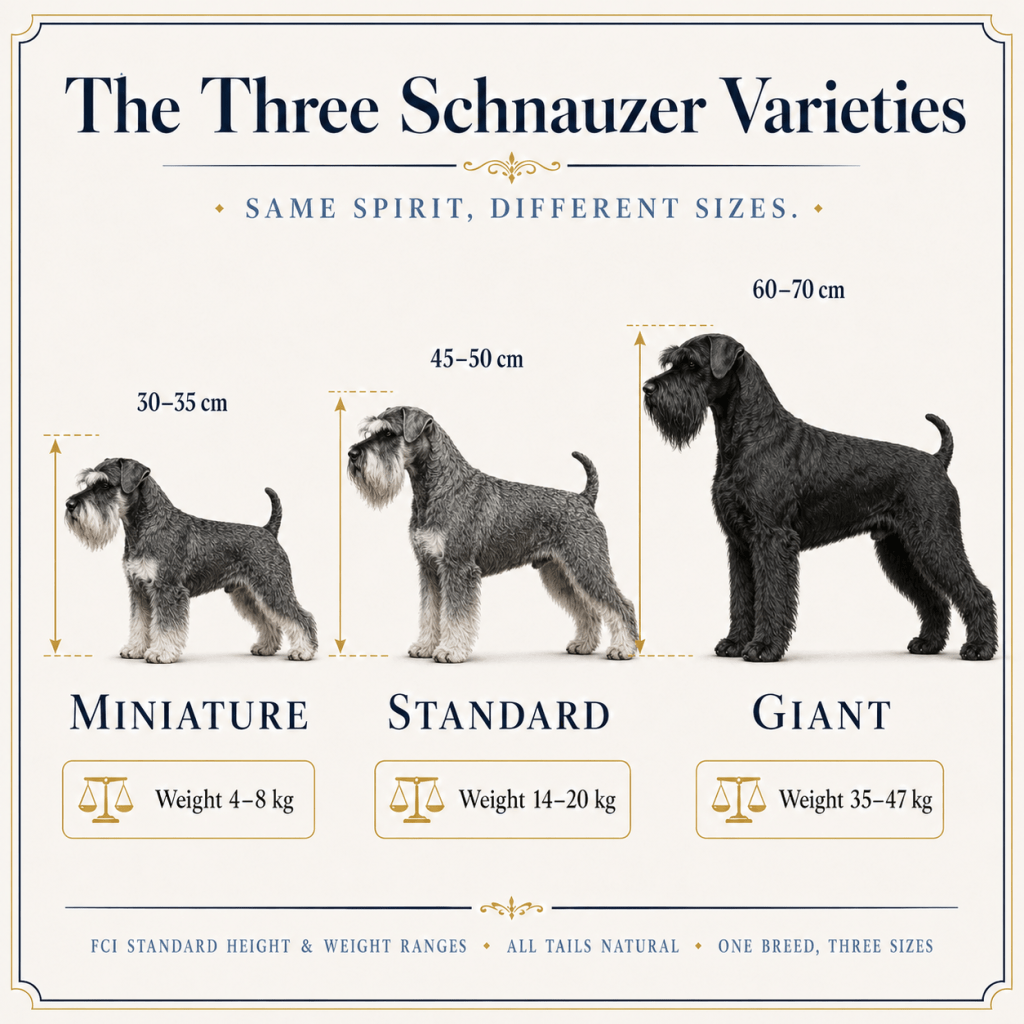
When most people meet a Schnauzer, they meet only one third of the breed. They meet the Miniature in a city park, or they meet a Giant in a working harness, and they assume the other sizes are scaled copies of the dog in front of them. They are not. The Schnauzer family is one German idea expressed in three deliberate scales, and each scale was bred for a job.
Understanding that idea changes how you choose one, how you breed one, and how you judge one.
The original Schnauzer was a working farm dog, not a fashion statement
The Standard Schnauzer is the prototype. Every modern history of the breed traces back to the wire-haired Pinscher of southern Germany — a robust, square, harsh-coated medium-sized dog kept on farms and in stables to control vermin, guard the smallholding, and travel with cattle. The German original standard for judges’ education, says it cleanly: the Standard is regarded as the original Schnauzer, and the Giant and the Miniature were developed from it. That detail matters more than it sounds, because once you know the Standard is the reference, you stop reading the Mini as “a small terrier” and the Giant as “a black show dog,” and you start reading them as variations of the same idea at different scales.
The Miniature was developed to do the Standard’s job in a smaller package — same temperament, same coat, same square outline, same alert presence, packaged for households and rat work in tighter spaces. The Giant was developed to do the Standard’s job at greater scale — moving cattle, guarding breweries and stockyards, and later doing serious utility and protection work for the German military and police. Same recipe, larger pot.
Three FCI standards, three sizes, one breed identity
Under the Fédération Cynologique Internationale, the three Schnauzers are listed in Group 2, Section 1: Pinscher and Schnauzer type. Their official standards are:
| Breed | FCI No. | Standard valid from | Working trial | Country of origin |
| Riesenschnauzer (Giant) | 181 | 25.05.2021 | Yes | Germany |
| Schnauzer (Standard) | 182 | 06.03.2007 | No | Germany |
| Zwergschnauzer (Miniature) | 183 | 06.03.2007 | No | Germany |
The Giant standard was updated in 2021. The other two have not been revised since 2007 and are written in tighter, older language. All three are authentic in their German originals, and the FCI publishes English, French and Spanish translations on its standards portal. The home-country authority is the Pinscher-Schnauzer-Klub (PSK) under the German VDH, with international coordination through the Internationale Schnauzer Pinscher Union (ISPU).
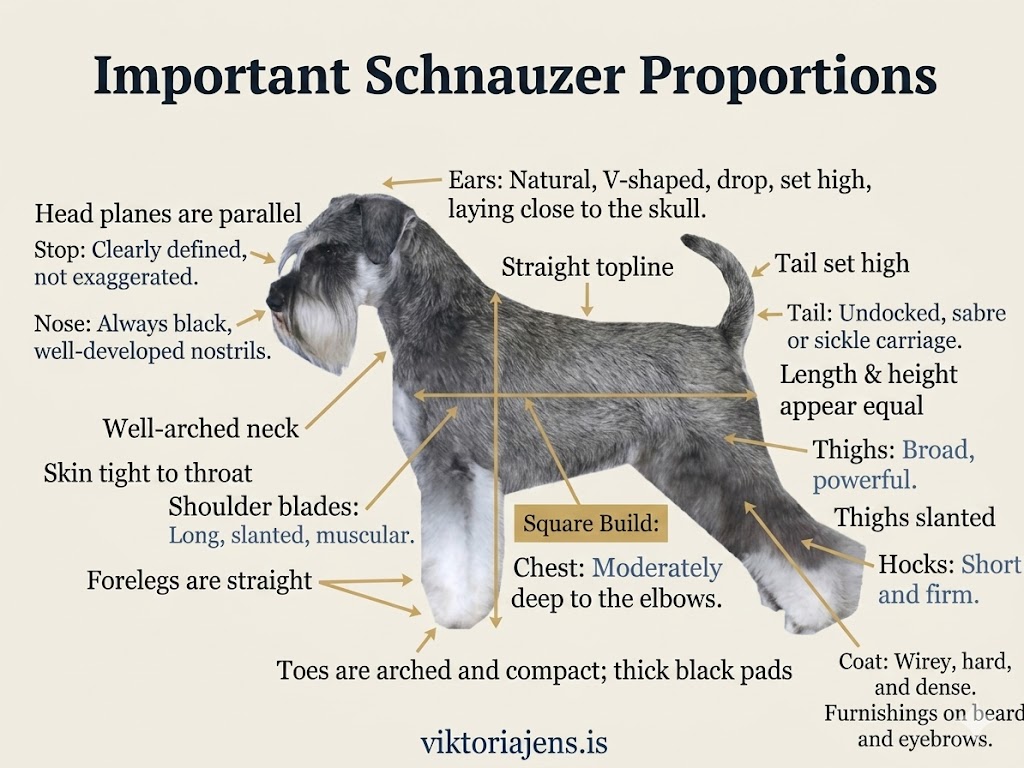
What unites all three standards, and what every judge needs to read for first, is one image: a square, strong, harsh-coated dog with a rectangular head, an alert and confident expression, and movement that proves the body can work. Everything else — coat colour, exact size, ring presentation — is variation around that common idea.
The signature line, before we go further
A Schnauzer is not a decorative low-shedding dog. It is a clever, opinionated working-type dog in a beard.
If a single sentence carries this whole article, that is the one. Hold onto it.
Same essence, different jobs — and different judging traps
Every size shares the same essence. Each one carries a different risk if a breeder, owner, or judge forgets the prototype.
Miniature Schnauzer (FCI 183)
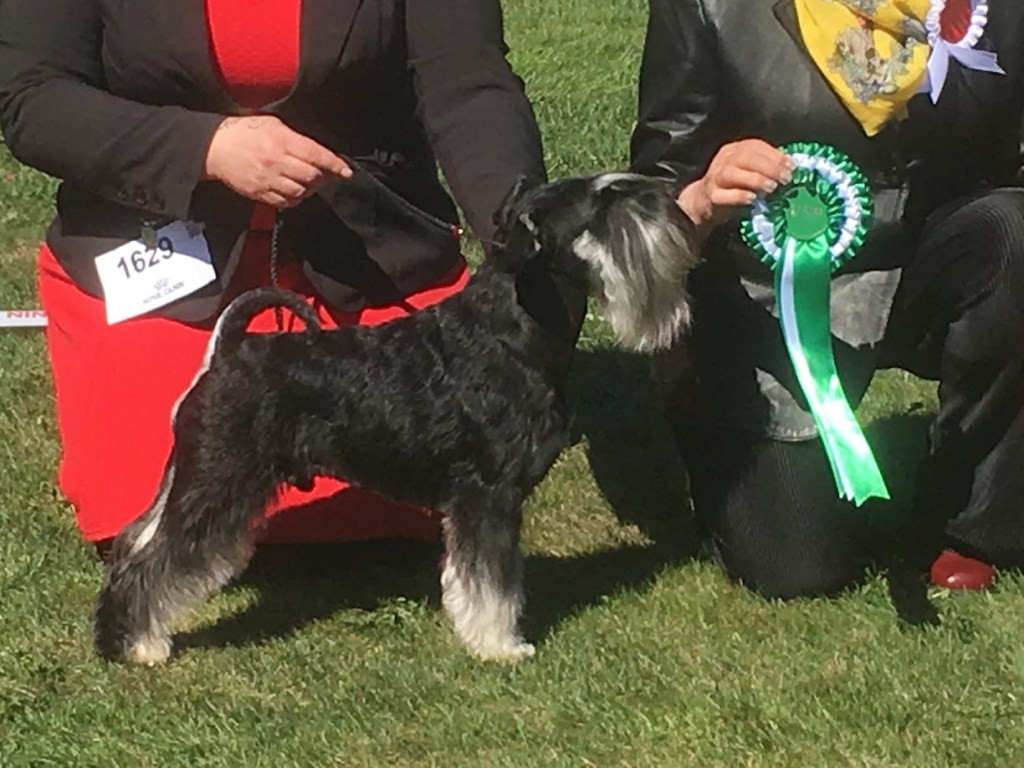
The Mini should be a reduced image of the Schnauzer — the Spanish and Swedish judges’ commentaries both use that phrase deliberately — never a dwarf and never a toy. The same square outline, the same harsh coat, the same forward-thinking temperament. The risk is drift toward something cute: round eye, refined bone, soft coat under skilful scissoring, and a handler trained to make the dog look smaller and sweeter than the standard intends. A correct Mini is a small, strong, vigorous dog who keeps the working temperament intact in a household-sized body.
The FCI accepts black, pepper and salt, black and silver, and white in the Miniature. The American Kennel Club accepts the first three but disqualifies white in conformation — one of the cleanest examples of how identical breeds diverge across registries.
Standard Schnauzer (FCI 182)
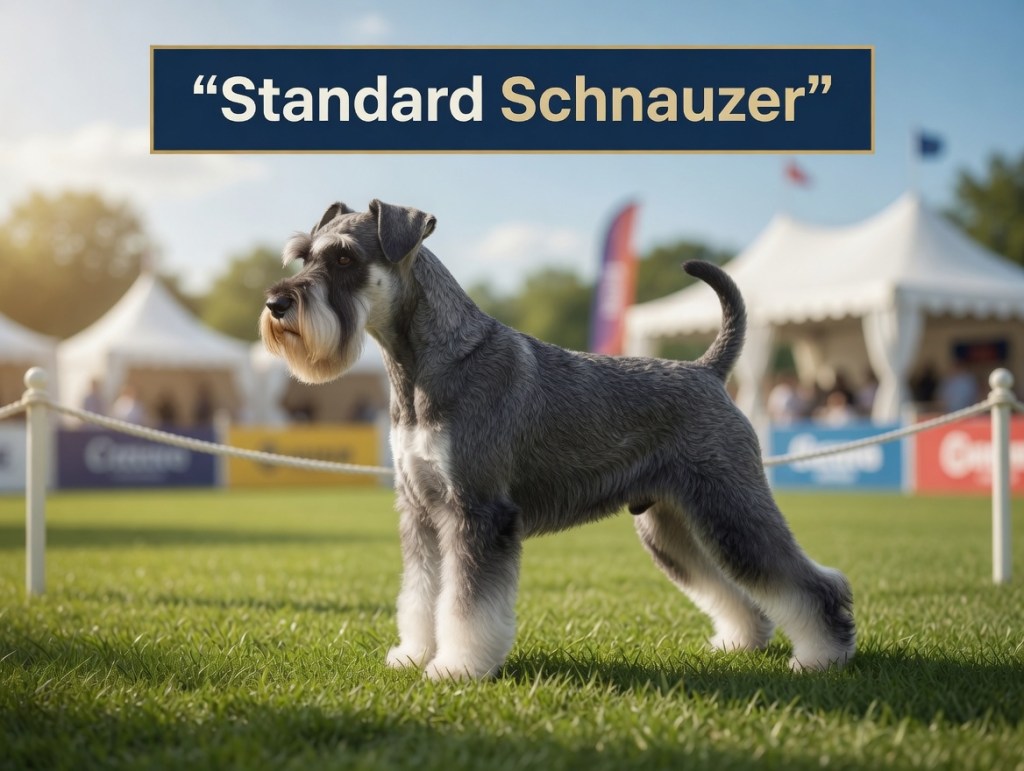
The Standard is the dog the family is built around, and the most under-discussed of the three. Everyone talks about Minis because they are popular pets and Giants because they are impressive. The Standard sits between them and gets overlooked, including in the show ring — and that is exactly why it deserves the most careful eye, not the least.
The colour palette here is narrower than people expect. Under the FCI standard, the Standard Schnauzer is recognised in only two colours: pepper and salt, and pure black with black undercoat. No black and silver. No white. This is one of the cleanest ways to remember the family — the Mini gets all four colours, the Giant gets three (since the 2021 update added black and silver for separate CACIB), and the Standard keeps to the two original colours of the prototype. If a Standard appears in the ring in any other colour, it is outside the standard, however attractive the dog.
The FCI versus AKC differences for the Standard are smaller than for the Miniature, but worth knowing. Both registries accept the same two colours. The size specifications match closely — 44 to 47 cm at the withers for the FCI Standard, 47 to 49 cm at the AKC. The most visible split is grouping: FCI keeps the Standard in Group 2 alongside the Mini and the Giant, while AKC places the Standard in the Working Group. AKC ring presentation still accepts cropped ears and docked tails for the Standard; FCI countries have moved decisively to natural ears and tails in line with European welfare conventions. Neither system requires a working trial title for breed championship — only the Giant carries that mark in the FCI system.
Its judging risks are different from the others: too long in body, too light in substance, soft coat texture, lack of the confident farm-dog character. Any of those moves the dog away from the prototype the whole family is calibrated against. Every judge who handles the family seriously should be able to picture a correct Standard before they walk into the ring with a Mini or a Giant, because the Standard is the calibration point. Lose the Standard from your eye and you start judging the Mini as a terrier and the Giant as a generic working dog.
Giant Schnauzer (FCI 181)
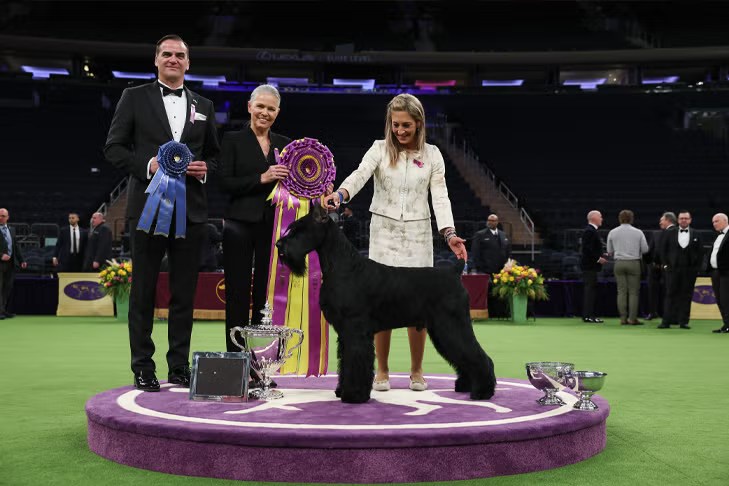
Picture from the American Kennel Club, the winner of Westminister 2025 “Monty”
The Giant Schnauzer is wire-haired, large, powerful, imposing, and — critically — more compact than slender. The Giant must not become coarse and mastiff-like, and it must not become elegant and Dobermann-like. Its temperament is described as good-natured, balanced, intelligent, trainable, brave and strong-willed. It belongs in working homes with experienced handlers.
The colour picture is the most active in the family right now. The FCI recognises three colour varieties for separate CACIB: pepper and salt, pure black with black undercoat, and black and silver — the third one added in the 2021 standard update. Many ringside spectators and even some judges still think of the Giant as primarily black, with pepper and salt as the secondary option, so the black and silver Giant remains genuinely under-recognised. The AKC, by contrast, still accepts only pepper and salt and solid black for the Giant, and a black and silver Giant cannot be shown in AKC conformation. This is the cleanest current divergence between the two registries within the Schnauzer family — and it is moving, not settled, so anyone judging or breeding the Giant should know which system they are working under.
The other FCI versus AKC differences sit where you would expect. Both systems specify near-identical size: 60–65 cm at the withers for females and 65–70 cm for males. Both place the Giant under “working” intent, but only the FCI formally marks the breed as a working-trial breed in its classification — a quiet but real signal that the FCI system expects the Giant to have a job, not only a ribbon. Group placement differs: FCI keeps the Giant in Group 2 with the Mini and the Standard; AKC moves it into the Working Group alongside Rottweilers, Dobermanns and other utility-class breeds. Cropped ears and docked tails are still seen in some AKC Giant rings; FCI countries have moved to natural ears and tails almost without exception.
Its judging risks are large-dog risks: heaviness in bone or skull that drifts toward mastiff type, over-elegance that drifts toward Dobermann type, weak rear or restricted movement under a powerful frame, and soft or sculpted coat that lets the dog look correct standing and falls apart in the trot. Underneath all of those, the same prototype dog: square, strong, harsh-coated, alert, and unmistakably a Schnauzer when your hands go through the coat.
FCI versus AKC — the comparison that matters most
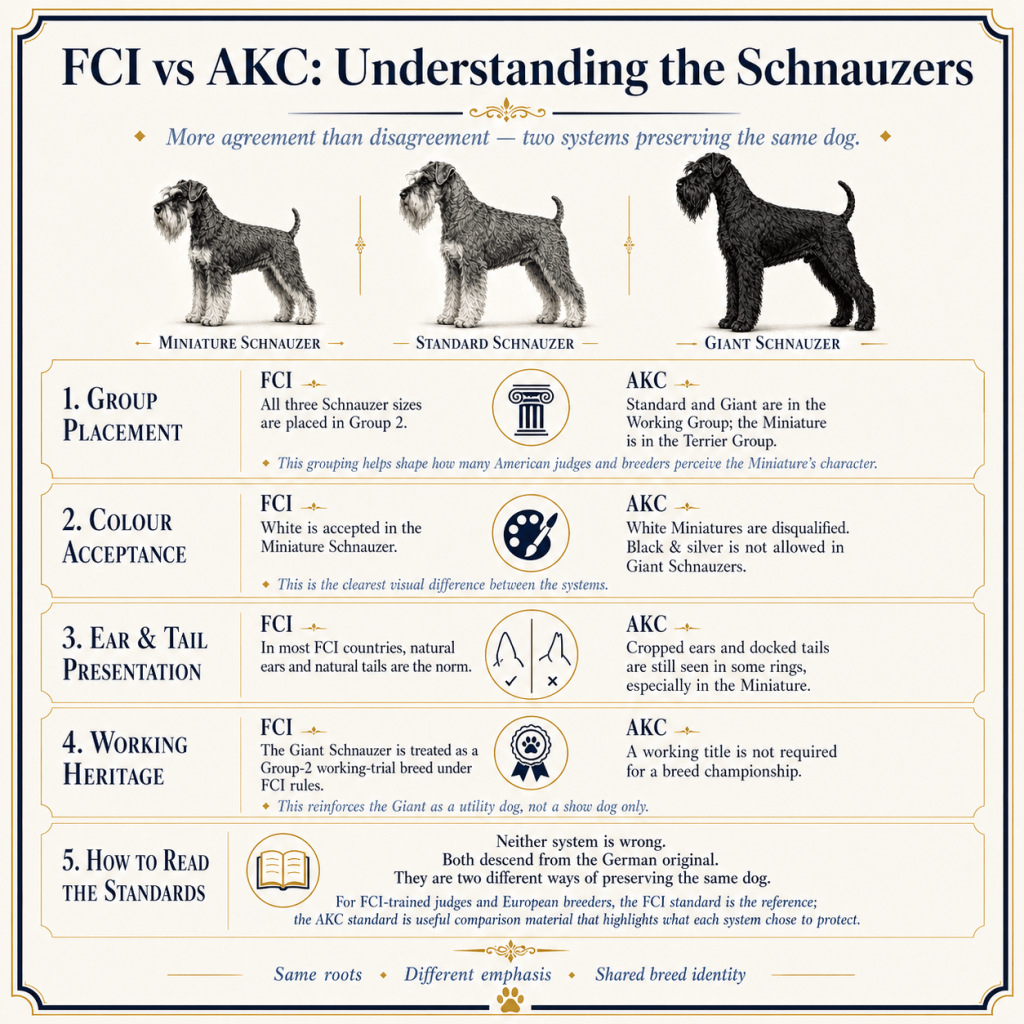
The two systems agree on more than they disagree. Both are descended from the German original. The most useful divergences for owners and judges to understand are:
- Group placement. FCI places all three Schnauzer sizes together in Group 2. AKC splits them: Standard and Giant sit in the Working Group, but the Miniature sits in the Terrier Group. This grouping shapes how American judges and breeders perceive the Mini’s character.
- Colour acceptance. FCI accepts white in the Miniature; AKC disqualifies it. For Giants black and silver is not allowed in AKC. This is the cleanest single difference between the two systems for the same breed.
- Ear and tail presentation. Cropped ears and docked tails are still seen in some AKC rings, particularly in the Mini. FCI countries have moved decisively to natural ears and tails, in line with European welfare conventions.
- Group-2 working trial. FCI marks the Giant Schnauzer as a working-trial breed under its rules, reinforcing that the Giant is a utility dog rather than a show breed only. AKC does not require a working title for breed championship.
Neither system is wrong. They are different ways of preserving the same dog. For an FCI-trained judge or a European breeder, the FCI standard is the reference; the AKC version is comparison material that highlights what each system chose to protect.
Three Breed Cards — the family at a glance
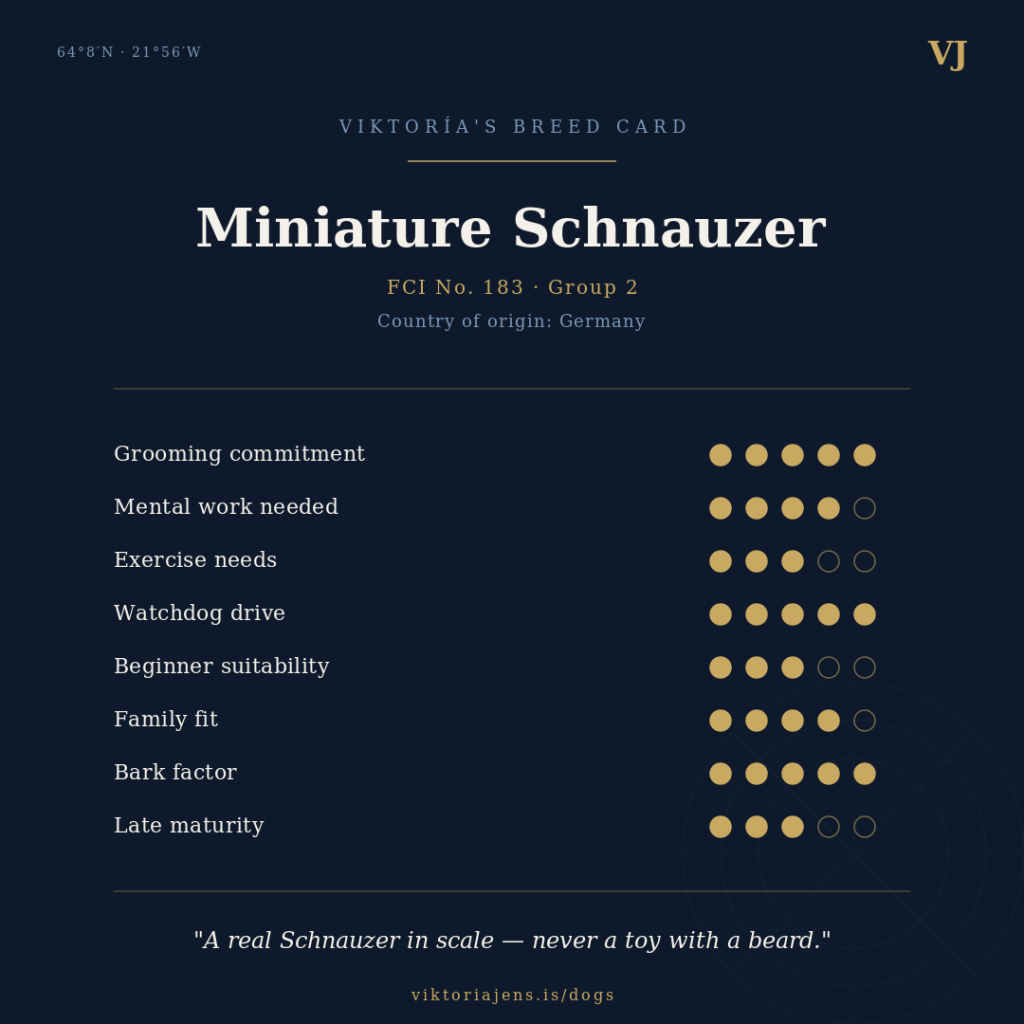
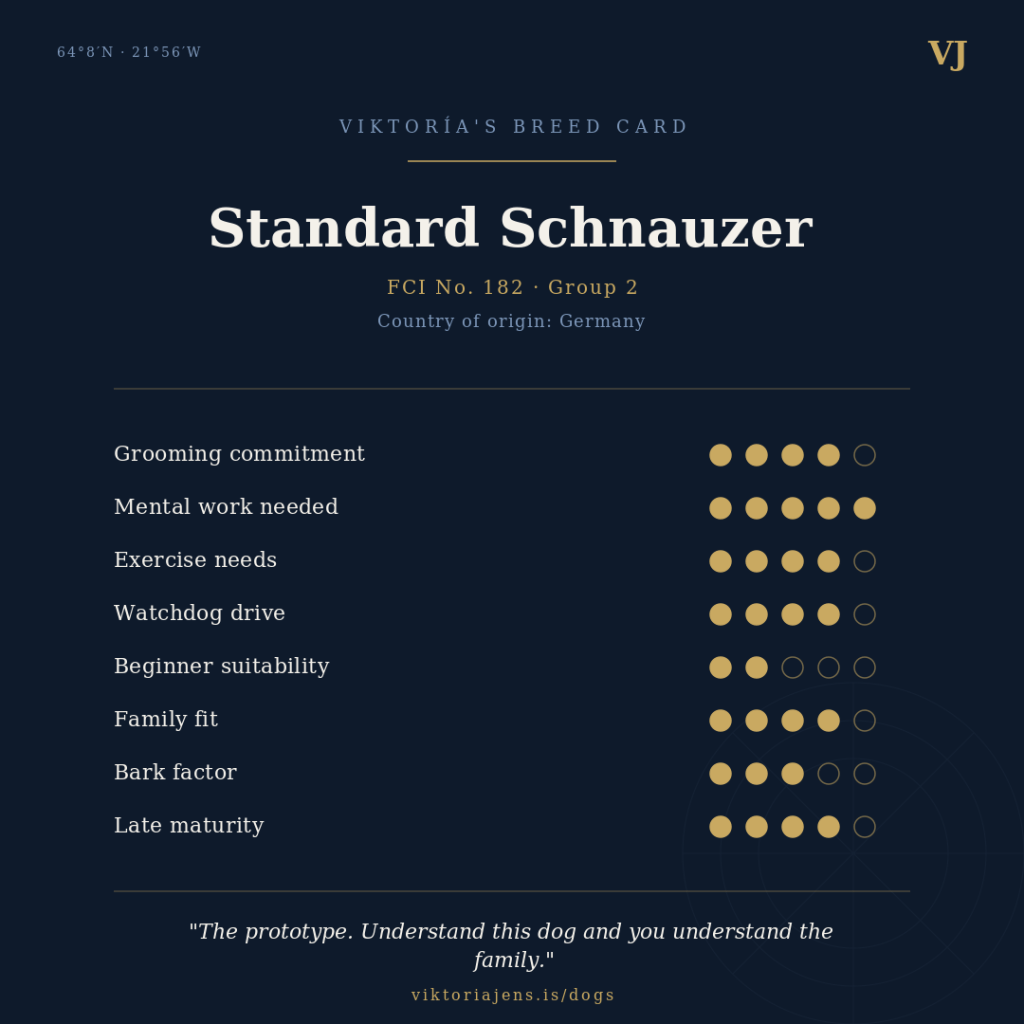
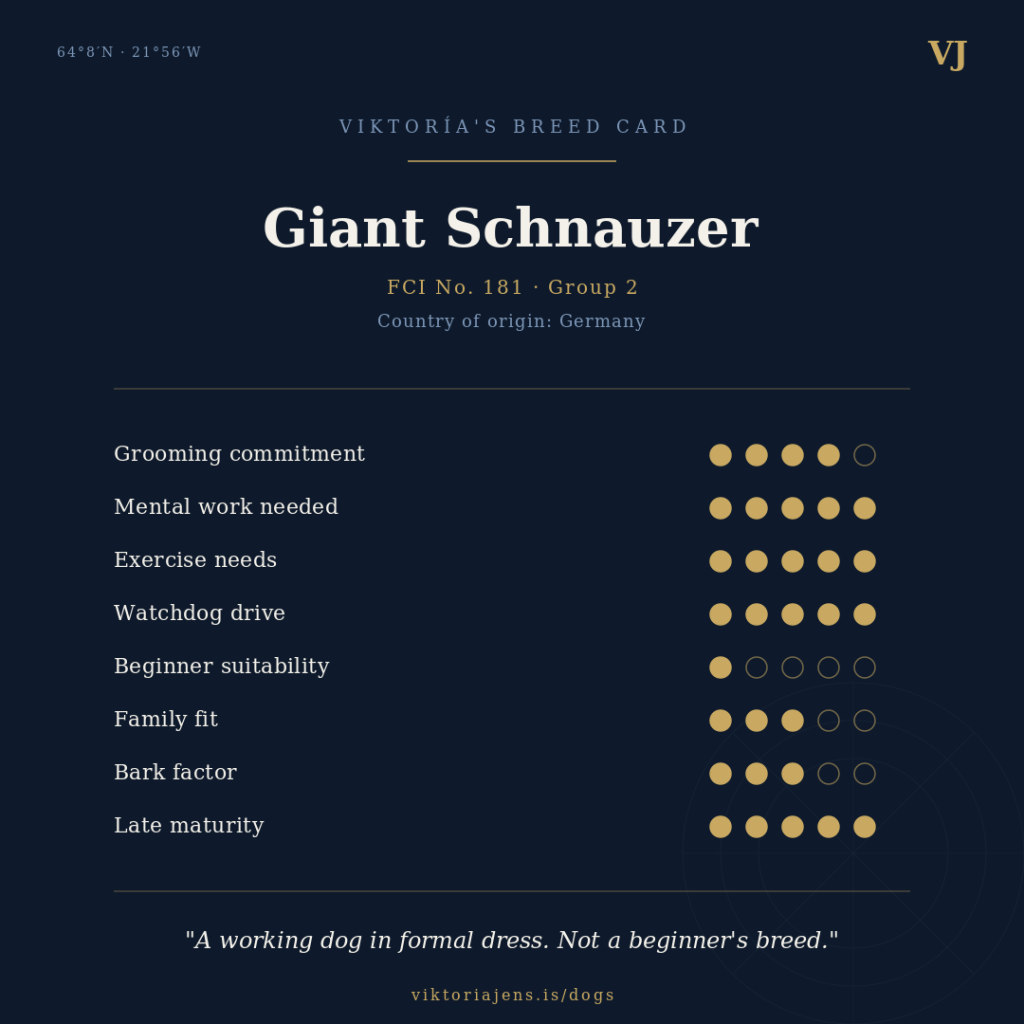
Each Schnauzer size deserves its own honest scorecard. These three cards appear in every breed article from now on, in the same eight categories, so the whole study list builds into a comparable library over time.
What this means for choosing one
If you are reading this because you are thinking about a Schnauzer, the most useful next step is the Which Schnauzer Are You? quiz — five honest questions that give you a starting answer before you contact a breeder. The fourth article in this series goes much deeper into ownership reality by size.
One small principle to carry from this article into the next three. Colour can deceive the eye in this breed family more than in most. A perfectly distributed pepper and salt can flatter a dog whose proportions are slightly off; an uneven distribution can pull attention from a dog whose structure is correct. The discipline that protects you from both directions is to read the dog with your hand as well as your eye. Your spread hand is a reliable internal measuring stick — the distance from your thumb tip to your little fingertip stays the same from ring to ring, and it lets you check squareness, chest depth, neck length and head proportions without trusting the silhouette the coat is presenting. The eye decides what to look at; the hand decides what is true. Article 3 is built around that principle, and it is worth bringing into every Schnauzer class you ever judge or steward, regardless of which size is on the table.
If you are reading this as a breeder or as a fellow judge, the most useful takeaway is to keep the Standard Schnauzer at the centre of your eye. When you can see the Standard clearly, the Mini stops looking like a terrier and the Giant stops looking like a generic working dog. They start looking like what they are: one German idea, well kept across three honest sizes.
Next in this series: Coat, Colour and the Genetics Behind Them — why the harsh coat is functional, what banded hair really is, and the colour choices that distinguish FCI from AKC.
One question to leave you with: of the three sizes, which one would your household actually deserve — not which one would you most enjoy showing off?
The views expressed here are my own. Judges and breeders should always refer to the FCI breed standard as the authoritative reference.
Sources for this article: FCI Standards 181, 182 and 183 (Fédération Cynologique Internationale); Swedish Kennel Club / SSPK Domarkompendium for Schnauzer, Dvärgschnauzer and Riesenschnauzer; Pinscher-Schnauzer-Klub (PSK / VDH); Internationale Schnauzer Pinscher Union (ISPU); American Kennel Club breed standards for Standard, Miniature and Giant Schnauzer.


Leave a comment